The AI Playbooks That No Longer Work in 2025, And What Replaces Them
The problem in 2025 isn’t model performance, it’s outdated playbooks. Companies are deploying more AI than ever, yet the economic impact is still uneven. Not because the technology stalled, but because most organizations are still operating with assumptions from 2023, while the constraints of 2025 have shifted to power, governance, and proof of value.
What changed in 2025
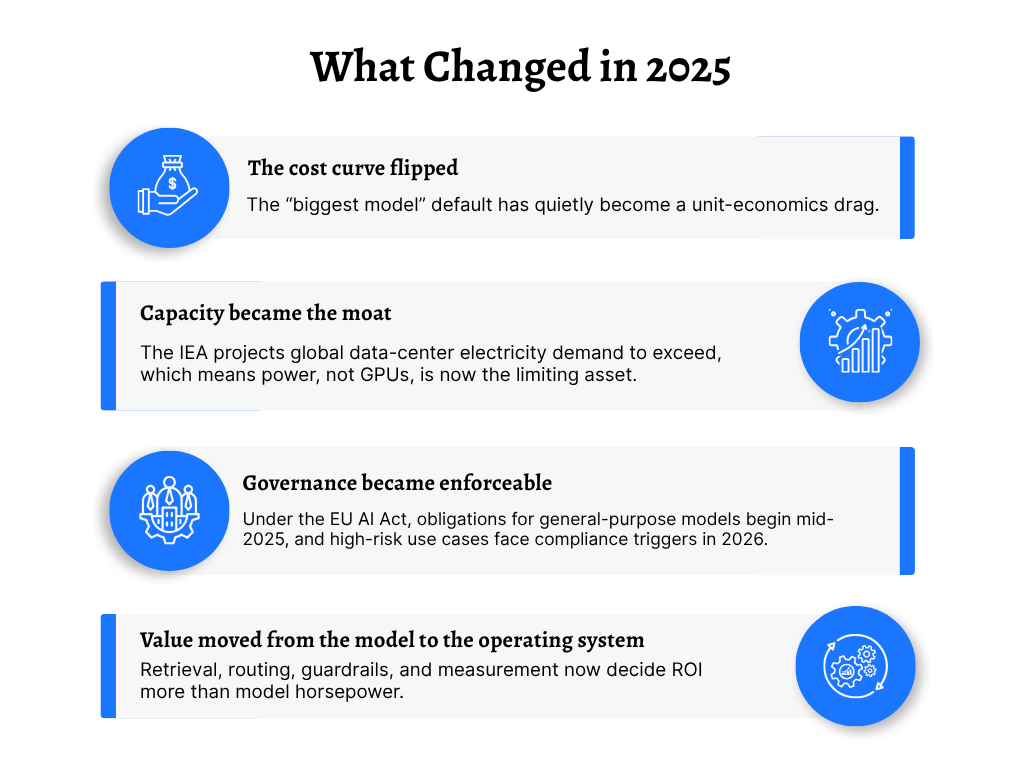
Four structural changes forced a reset:
The cost curve flipped: The “biggest model” default has quietly become a unit-economics drag.
Capacity became the moat: The IEA projects global data-center electricity demand to exceed 1,000 TWh by 2026 — roughly the consumption of Japan — which means power, not GPUs, is now the limiting asset.
Governance became enforceable: Under the EU AI Act, obligations for general-purpose models begin mid-2025, and high-risk use cases face compliance triggers in 2026, tied to ISO 42001-style evidence.
Value moved from the model to the operating system: Retrieval, routing, guardrails, and measurement now decide ROI more than model horsepower.
This is why AI in 2025 is no longer about deployment, but about operational readiness.
The CEO maturity diagnostic
Before looking at solutions, this is the only diagnostic that matters now:
If you cannot answer YES to at least four, you’re scaling experimentation, not outcomes:
Do we route workloads across a portfolio, instead of defaulting to one model?
Can we demonstrate retrieval quality (faithfulness + freshness + permissions)?
Do we measure unit economics (cost per successful task / cycle-time gain)?
Are guardrails mapped to NIST / OWASP / ISO 42001, not just policy PDFs?
Are we on track for EU AI Act 2025-26 obligations?
Do we plan for capacity and power, not just cloud compute?
In every real deployment I’ve seen, the turning point wasn’t the model, it was when the organization finally treated AI like infrastructure, not an experiment. The companies that scale aren’t those buying the best model, but those building the most disciplined system around it.
The playbooks that no longer work
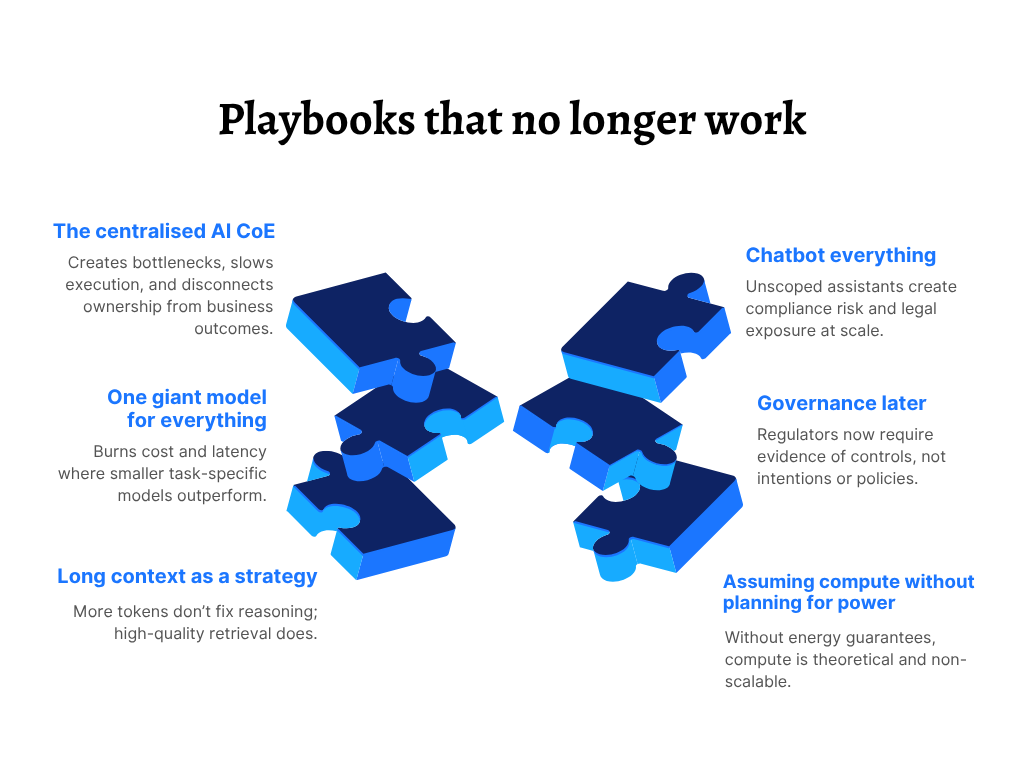
The centralized AI CoE A single “AI command center” creates friction and removes domain ownership. The winning model is hub-and-spoke: the core governs; the business units deliver.
One giant model for everything Enterprise workloads don’t need the heaviest model by default. Frontier models now handle edge cases, not the 80%.
Long context as a strategy More tokens ≠ more reasoning. Relevance decay still shows up. Retrieval quality matters more than context length.
Chatbot everything After the 2024 Air Canada ruling, unconstrained chatbots turned from “experience layer” into “liability surface.”
Governance later There is no “later”, EU AI Act enforcement starts this cycle, and it expects proof, not posture.
Assuming compute without planning for power Cloud scale means nothing if you can’t secure energy. Leaders are now locking capacity, not renting and hoping.
What replaces them in 2025
Model portfolios with routing: Right model → right job → right cost. That is the new performance edge.
RAG as a governed system: Evaluation is the product. Retrieval quality is the KPI.
Guardrails mapped to real standards: OWASP LLM | NIST GenAI Profile | ISO 42001 alignment = defensibility.
Value-first deployment: A Global AI Survey found only ~10% of companies using GenAI see material EBIT lift, and the differentiator is KPI tracking tied to discrete business workflows, not AI licensing volume.
Energy-aware scaling Siting, cooling, redundancy, and throughput are now strategic choices, not IT afterthoughts.
Cross-industry proof
A top-5 Middle Eastern retail bank routed small models for routine screening and frontier models only for edge cases delivered ≈20% faster credit turnaround with lower inference cost.
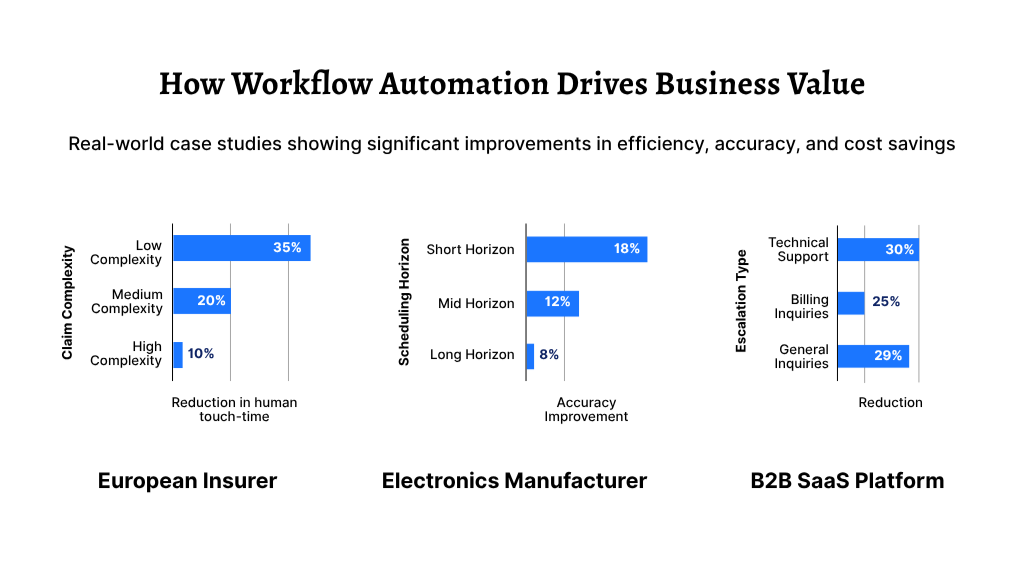
A Tier-1 European insurer shifted from chatbots to governed workflow agents cut ≈35% of human touch-time for low-complexity claims.
A global electronics manufacturer split a monolithic forecaster into orchestrated task-specific models that increased short-horizon scheduling accuracy by ≈18%.
A B2B SaaS support platform with predominantly US enterprise clients measuring cost per successful resolution instead of “usage” reduced escalations by ≈28% and lowered GPU load.
Different verticals, identical shift: value is no longer in the model, but in the operating system behind it.
The shift that defines 2025
In 2024, AI rewarded experimentation. In 2025, it rewards operating discipline.
The moat is no longer “who adopted AI”, it’s who can govern, route, measure, and power it at scale.
If you’re rethinking your AI operating model and want to benchmark where your organization sits on this maturity curve, I’m happy to have the deeper conversation.
As enterprises connect AI agents to live workflows, security risks extend beyond the model. Learn how prompt injection, excessive access, weak governance and poor oversight can expose business systems—and how leaders can secure AI agents from the start.
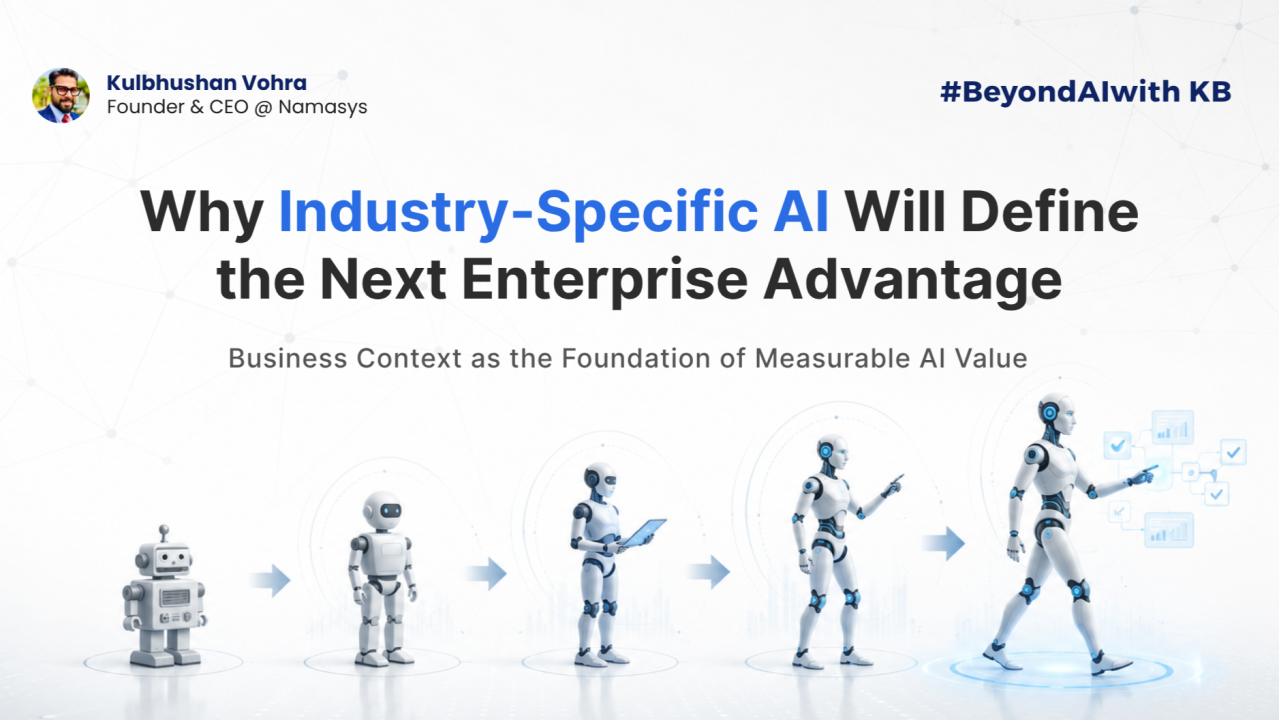
Generic AI improves productivity, but industry-specific AI creates measurable business value by combining enterprise data, workflows, governance and domain expertise. Explore why context will define the next phase of AI adoption.
Namasys Powers What’s Next for Your Enterprise
Bring clarity, efficiency, and agility to every department. With Namasys, your teams are empowered by AI that works in sync with enterprise systems and strategy.

.png)