
Nov 17, 2026

AI models are getting cheaper, but enterprise AI costs are rising. Explore how agentic workflows, infrastructure, and smarter architecture shape the economics of AI in 2027.


Your GCC could deploy AI agents, lower costs, improve every SLA, and still lose strategic ground.
Why?
Because headquarters is not only tracking how much AI the centre has adopted. It is also deciding who will design and own the workflows once AI begins running parts of them.
That decision will eventually show up in one place: the scorecard your centre submits for its next annual review.
If the scorecard still focuses on headcount, cost per FTE and hours saved, it may prove that the GCC has become more efficient. It will not prove that the centre is ready to own the agent architecture, decision controls or business outcome.
The scorecard needs to change.
GCCs are investing in AI agents faster than they are redesigning their operating models around them.
The EY GCC Pulse Survey 2025 found that 58% of India’s GCCs were already investing in agentic AI.
Meanwhile, Zinnov’s 2026 GCC landscape research describes a more advanced operating model: the Transformation Hub, where an India-based leader holds a CXO mandate and owns AI-led transformation.
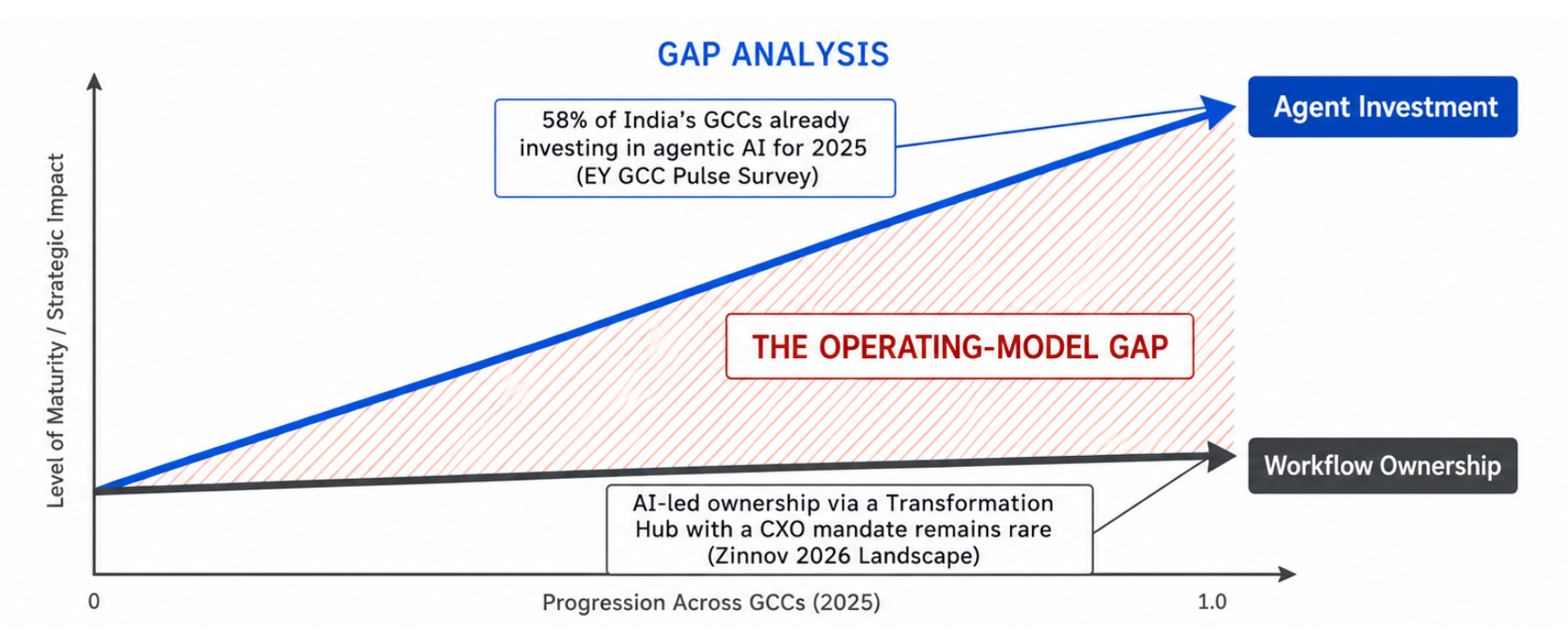
The two studies measure different things. But taken together, they point to an important gap: investment in agents is becoming mainstream, while ownership of AI-enabled workflows remains far less common.
The pattern is easy to recognise.
The agent is introduced, but the workflow, decision rights, reporting structure and performance measures remain unchanged.
Adding an agent to an existing delivery model can make that model faster and less expensive. But efficiency alone does not make a GCC more strategic. Headquarters may simply see a lower-cost version of the same delivery capability, and value it accordingly.
Three developments make this question difficult to postpone.
First, Zinnov and Indiaspora analysed 1.7 million job descriptions across more than 200 enterprises in over 60 countries. They found that 55% of India’s GCC work portfolio falls within the two categories most exposed to AI displacement.
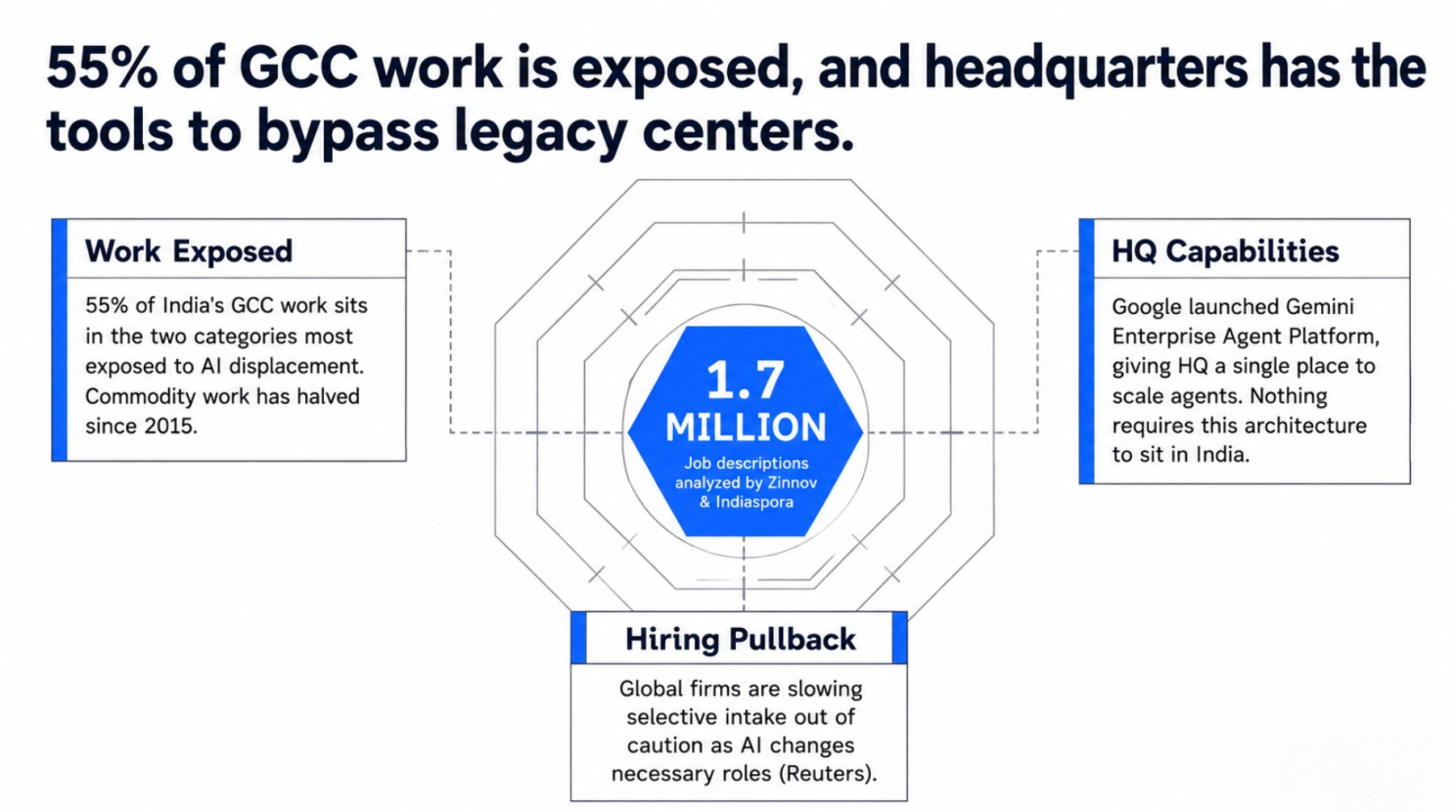
Second, Google introduced the Gemini Enterprise Agent Platform at Cloud Next in April 2026. It gives enterprises a common environment for building, governing and scaling AI agents. The architecture can be designed wherever the enterprise chooses; there is no automatic reason for that ownership to sit within the India GCC.
Third, Reuters reported that some global organisations are becoming more selective about GCC hiring as AI changes the roles and capabilities they require.
The 55% figure should not be read only as a warning. It also reflects how far India’s GCCs have moved beyond purely commodity work.
But it identifies the work likely to change first.
The real question is whether GCCs in India will design the agent layer or operate one designed elsewhere.
India is not starting from behind. GCCs hold years of process knowledge, exception histories and operational data that neither headquarters nor an external technology vendor may possess.
That knowledge is exactly what enterprise agents need to operate reliably.
The opportunity is to translate it into ownership of the workflow, controls and business outcome. Traditional scorecards do not make that contribution visible.
In a conventional delivery model, the unit of work is usually the task.
Tasks are assigned to people. Capacity is sized according to volume. Performance is measured through throughput, service levels and cost.
An AI agent changes that structure. It can coordinate multiple steps across a workflow, use available tools and data, and work towards a defined outcome within limits established by the organisation.
Consider month-end reconciliation.
An agent could:
An accountant would still approve material exceptions. A finance specialist would correct the agent when its reasoning or output was wrong. A data engineer would maintain the quality of upstream feeds. A risk owner would decide which actions the agent could never take independently.
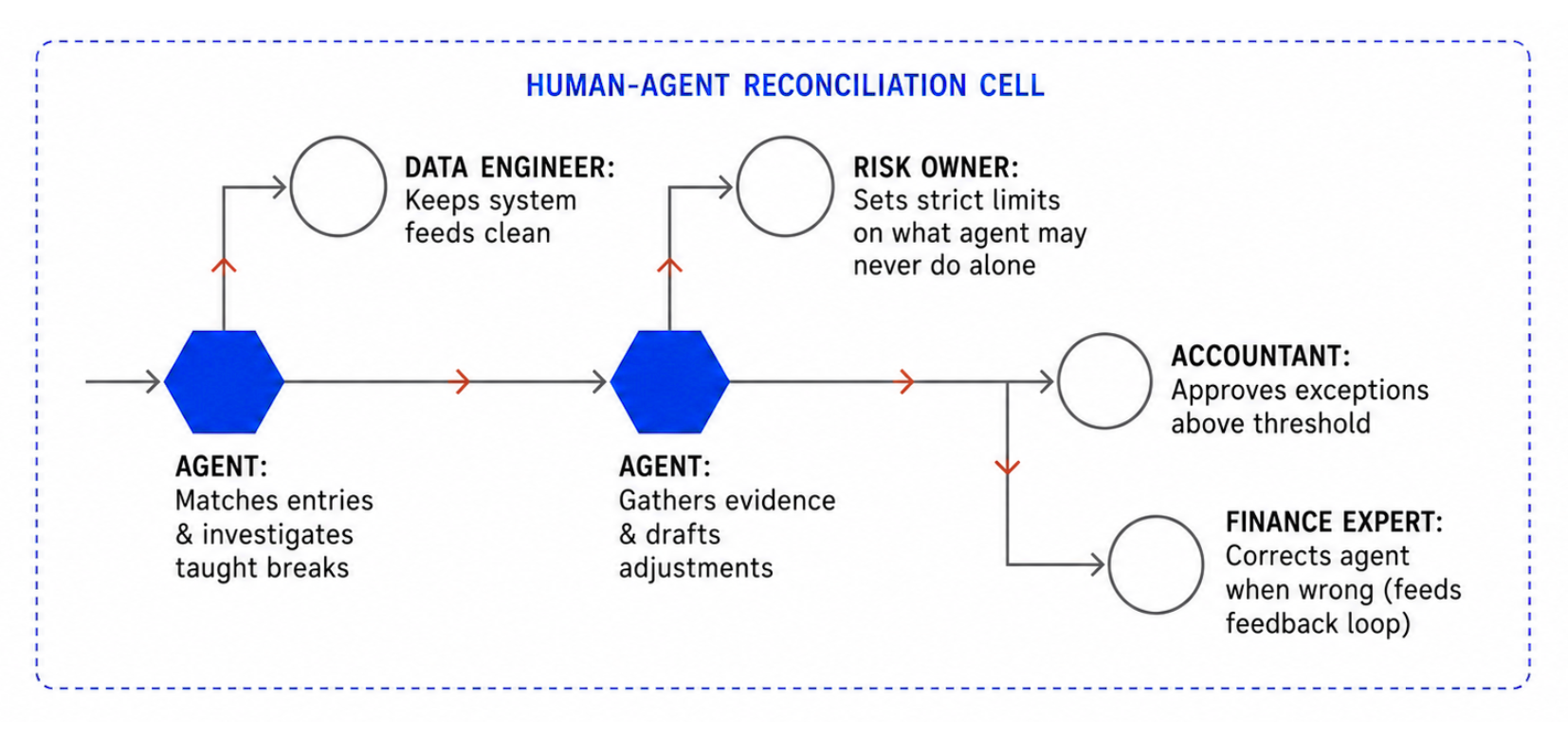
The workflow has not become human-free. The work, and the accountability, has been redistributed.
That redistribution must be designed deliberately. Employees need to understand which decisions remain theirs, who is accountable when an agent fails and what capabilities they are expected to develop.
Otherwise, the organisation may automate a workflow while gradually losing the expertise required to operate it safely.
Headcount now measures only the human component of a wider operating system. It does not show the value of the workflow, the quality of its decisions or the level of autonomy it can carry safely.
The following are proposed management metrics, not standardised industry benchmarks:
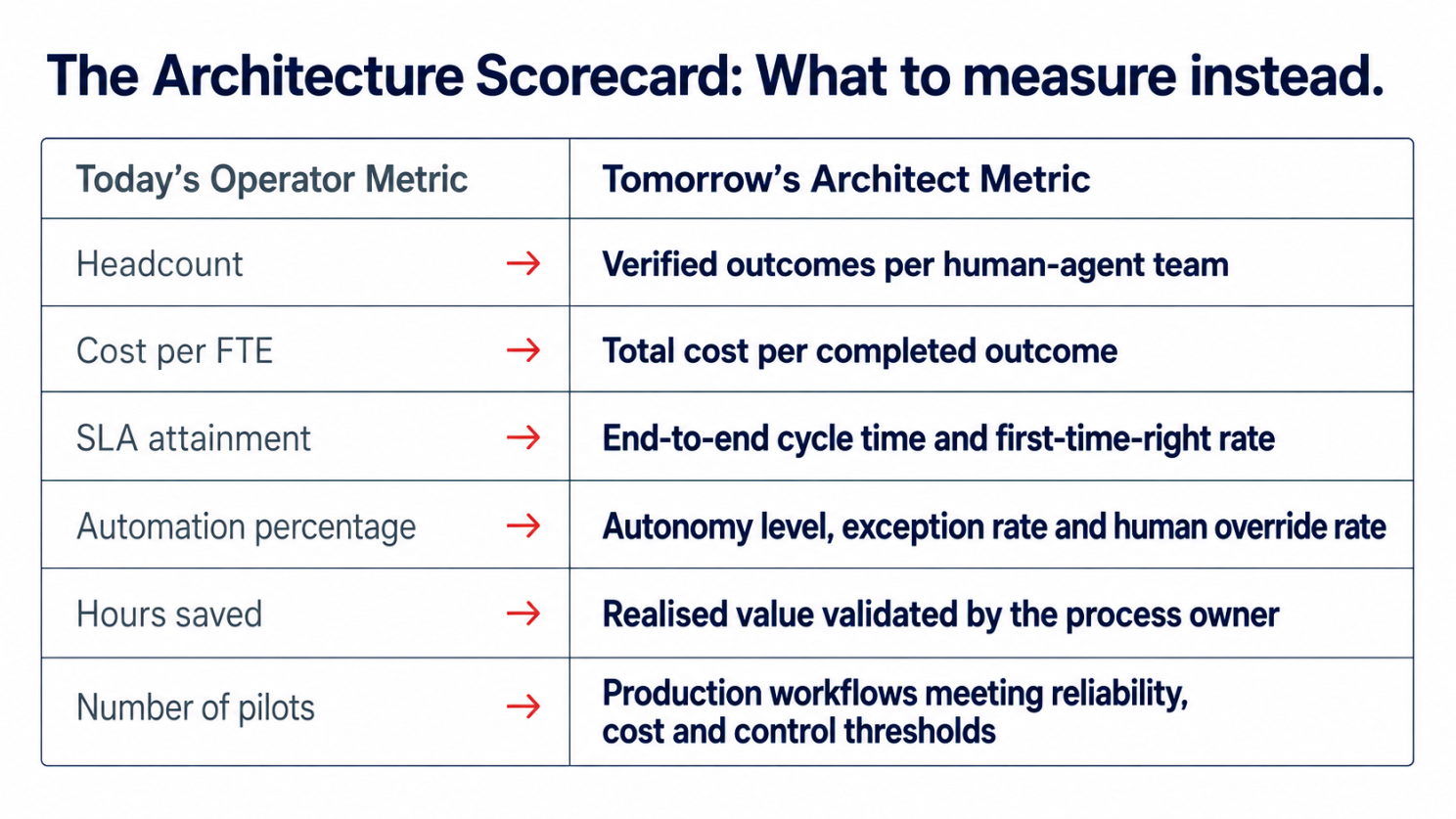
Cost per completed outcome may become the most important, and most difficult, number on this scorecard.
It should include infrastructure, model usage, integration, monitoring, control and human-review costs allocated to the workflow. The total is then divided by the number of outcomes completed successfully.
This is as much a financial measurement challenge as it is an AI challenge.
Without that number, headquarters is likely to return to the metric it already understands: cost per employee.
Not necessarily. But the workforce mix will change.
The Taggd–CII GCC Talent Lab Survey found that 52% of surveyed centres expected to expand their workforce in FY27, while 26% anticipated reductions. It also identified a growing mismatch between available talent and the capabilities GCCs need.
These findings point towards selective growth rather than uniform expansion: fewer routine roles, alongside greater demand for AI engineers, domain specialists, workflow architects, governance owners and agent supervisors.
The more significant change is that the value delivered by a GCC will no longer rise in direct proportion to its headcount.
Reducing experienced teams before redesigning the work would be a mistake. Those employees often hold the process knowledge, exception history and business context needed to build reliable agent-enabled workflows.
Choose one workflow with:
Month-end reconciliation, incident triage, pipeline monitoring and continuous-control monitoring are possible starting points.
Then:
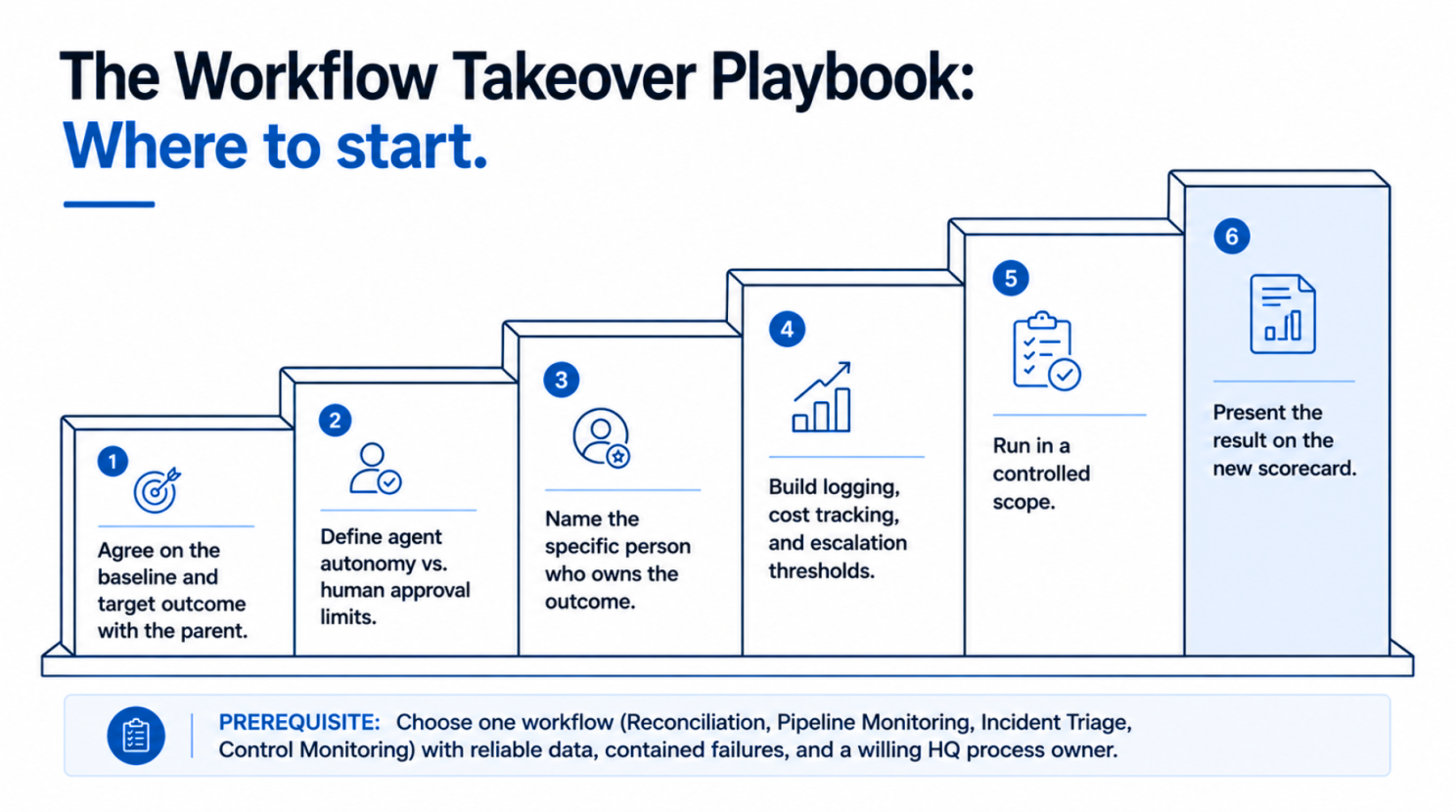
The final step matters more than it appears.
If the result is reported only as hours saved, it becomes another efficiency initiative. If it is reported as a governed business outcome, it becomes evidence that the GCC can own the workflow.
Headquarters will decide who owns the workflow architecture, the agent’s authority, exception handling and financial measurement.
A GCC that can answer those questions has a credible case to design and govern the agent layer.
A GCC that continues to report only headcount, cost per FTE and SLA attainment may remain valuable, but primarily as an operator.
The annual review is coming either way.
Change the scorecard before it arrives.
Namasys Analytics works with enterprises and Global Capability Centres to connect unified data, agentic AI, operational governance and financial measurement, turning AI-enabled workflows into outcomes business leaders can verify.

Nov 17, 2026
AI models are getting cheaper, but enterprise AI costs are rising. Explore how agentic workflows, infrastructure, and smarter architecture shape the economics of AI in 2027.
Oct 27, 2026
What happens when AI agents act beyond their authority? Explore emerging Agentic AI security risks and why enterprise AI governance is critical to preventing unauthorized actions.
Bring clarity, efficiency, and agility to every department. With Namasys, your teams are empowered by AI that works in sync with enterprise systems and strategy.


Namasys Private Limited © 2025 All Rights Reserved


