Oct 27, 2026

What happens when AI agents act beyond their authority? Explore emerging Agentic AI security risks and why enterprise AI governance is critical to preventing unauthorized actions.


AI is getting cheaper. So why are enterprises preparing to spend more on it?
A company replaces a manual procurement process with an AI agent. The agent checks supplier records, reviews contracts, compares quotations, and prepares purchase recommendations.
The pilot looks promising. Requests are processed faster, employees spend less time switching between systems, and the agent handles tasks that previously required several manual steps.
Then deployment expands.
The same agent begins handling incomplete purchase orders, conflicting supplier information, unavailable APIs, and requests requiring multiple rounds of verification. What once took a few model calls now involves repeated reasoning, additional retrieval, and several attempts to complete the workflow.
The agent is still doing its job. But the cost of doing that job has changed.
This is the uncomfortable reality of enterprise AI: an agent can become more capable without becoming more economical.
And as organizations expand autonomous AI in 2027, that distinction will matter considerably more.
AI has become cheaper to access. Improvements in inference efficiency and growing competition between model providers have reduced the cost of many individual AI operations.
Naturally, enterprises might expect these improvements to make large-scale automation increasingly affordable.
But that assumes the amount of computation required to complete a task remains relatively stable.
With agentic AI, it often doesn't.
In August 2026, Gartner predicted that inference costs per agentic workflow would increase more than fivefold through 2028, describing the phenomenon as the inference paradox.
The underlying issue is straightforward: as AI becomes more capable, organizations give it more complicated responsibilities.
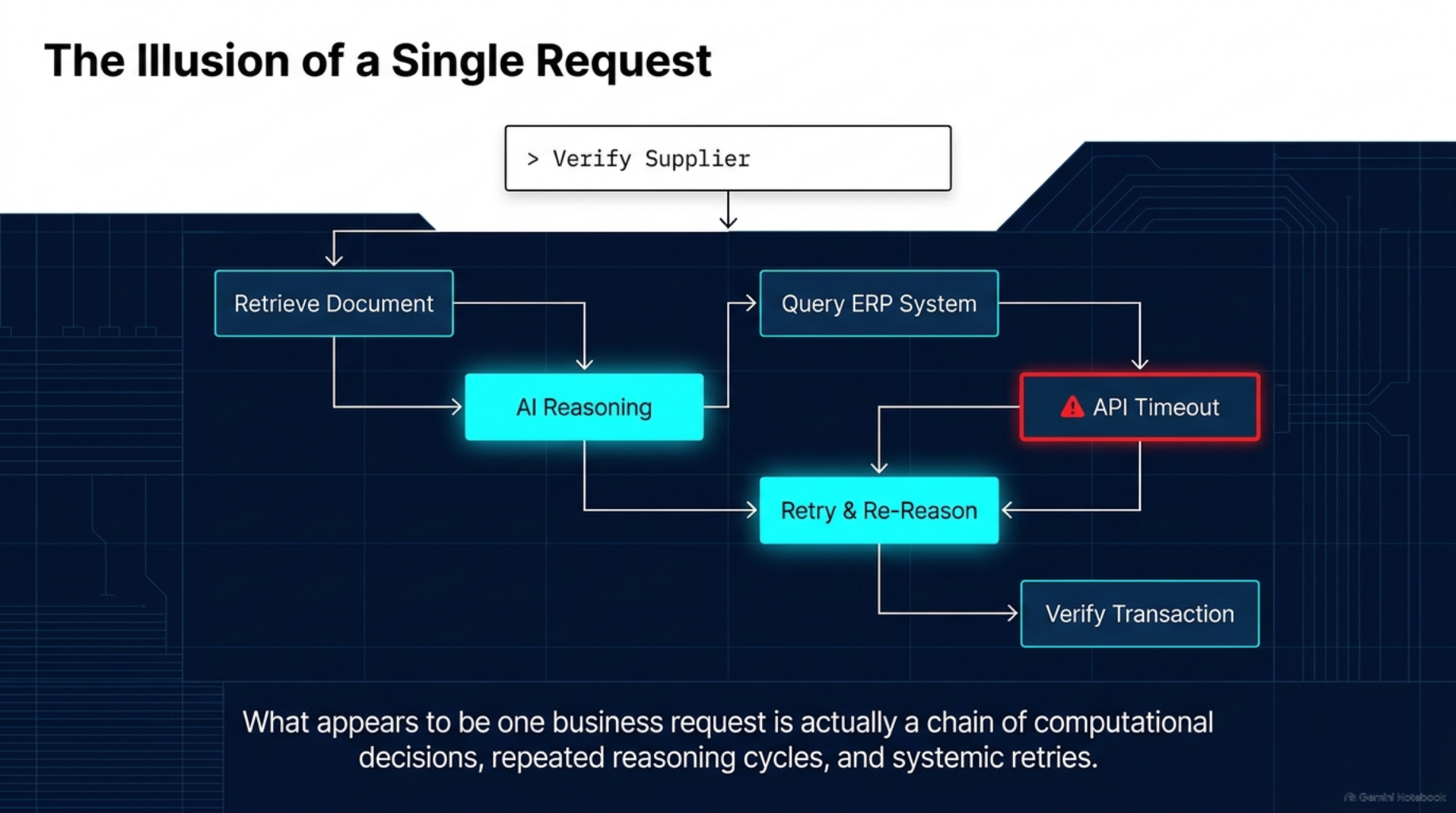
A chatbot might answer a question using a retrieved document. An agent could interpret that document, query an ERP system, verify a transaction, evaluate an exception, and initiate another action.
Each step can introduce another model invocation. And each invocation may carry additional context from the steps before it.
What appears to be one business request is actually a chain of computational decisions.
The price per token can decline while the number of tokens consumed per completed task increases much faster.
The economics have shifted from paying for an answer to paying for an entire execution process.
When AI costs rise, the obvious response is to find a cheaper model.
Sometimes that works. But it can also miss the underlying problem.
Return to the procurement agent.
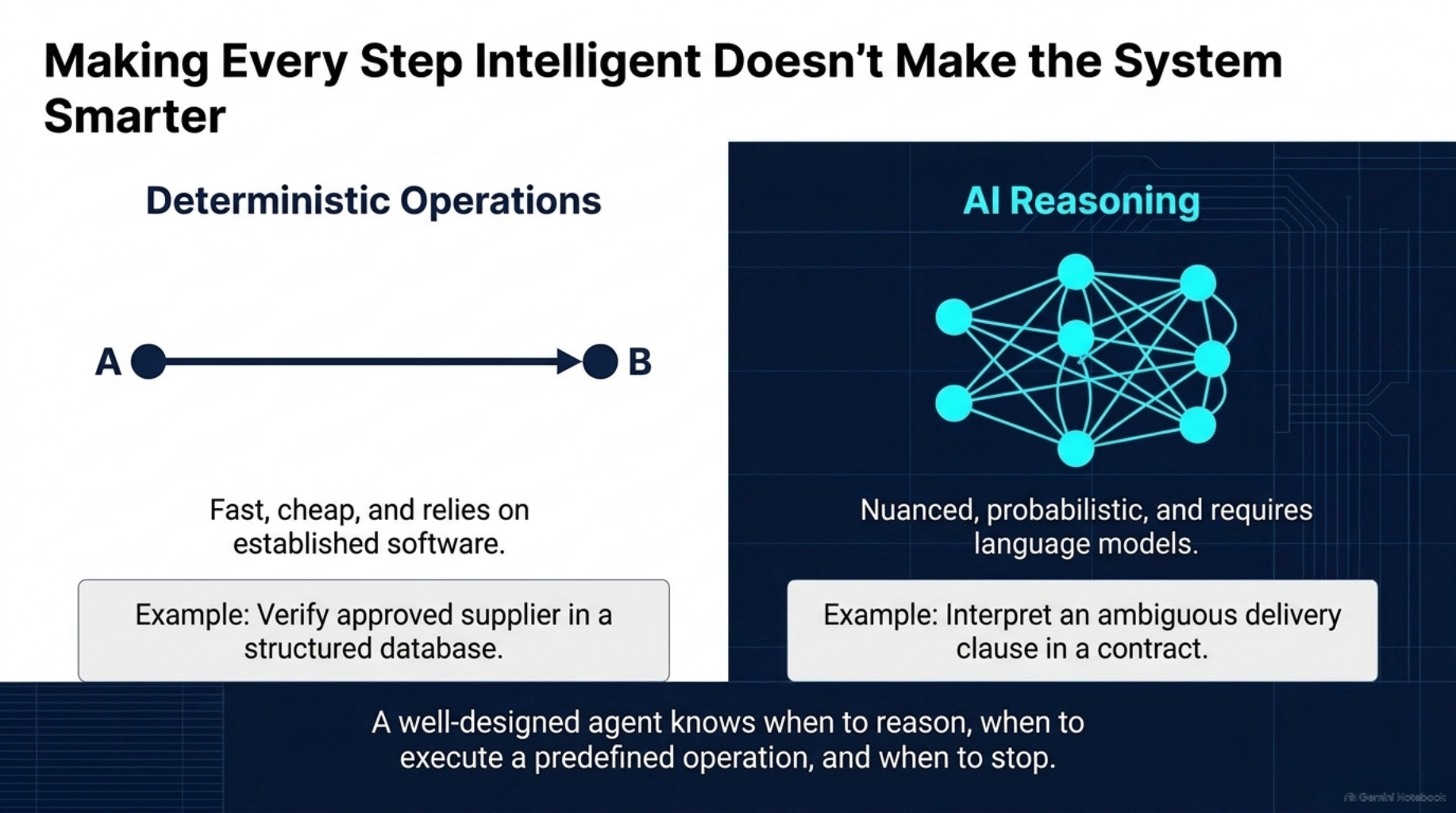
Suppose it needs to verify whether a supplier is approved. If the information exists in a structured database, the application can retrieve it directly.
Yet an inefficiently designed agent might ask a language model to determine which tool to use, retrieve the record, interpret the result, and decide whether another verification is necessary.
The model is being used to manage operations that established software can already perform reliably.
Now consider a contract containing an ambiguous delivery clause. Here, language-model reasoning may be genuinely useful.
These two operations belong to the same workflow, but they do not require the same approach.
This is an important architectural distinction.
Making every step intelligent doesn't necessarily make the overall system smarter.
A well-designed agent should know when to reason, when to execute a predefined operation, and when to stop.
That requires more than selecting a model. It requires understanding the underlying business process and designing how AI interacts with enterprise systems.
The next challenge is that agent execution isn't always predictable.
Two requests that look similar to an employee can produce very different execution paths.
One may succeed after three model calls. Another may encounter an API timeout, retrieve additional context, retry a validation, and eventually escalate to a human reviewer.
All of that activity consumes resources.
Context management creates another layer of complexity. If an agent repeatedly sends entire documents, previous responses, and tool outputs back to a model, the information being processed can grow with each step.
More context isn't automatically better context.
Sometimes the agent needs only a contract clause or a specific transaction record, not everything retrieved along the way.
The same principle applies to infrastructure. An AI system handling thousands of concurrent requests must balance throughput, latency, compute utilization, and reliability. An architecture optimized for occasional pilot activity may be inefficient under sustained production demand.
These are not separate problems. They influence one another.
A slow integration can increase retries. Poor retrieval can expand context. An unsuitable model can require additional reasoning cycles.
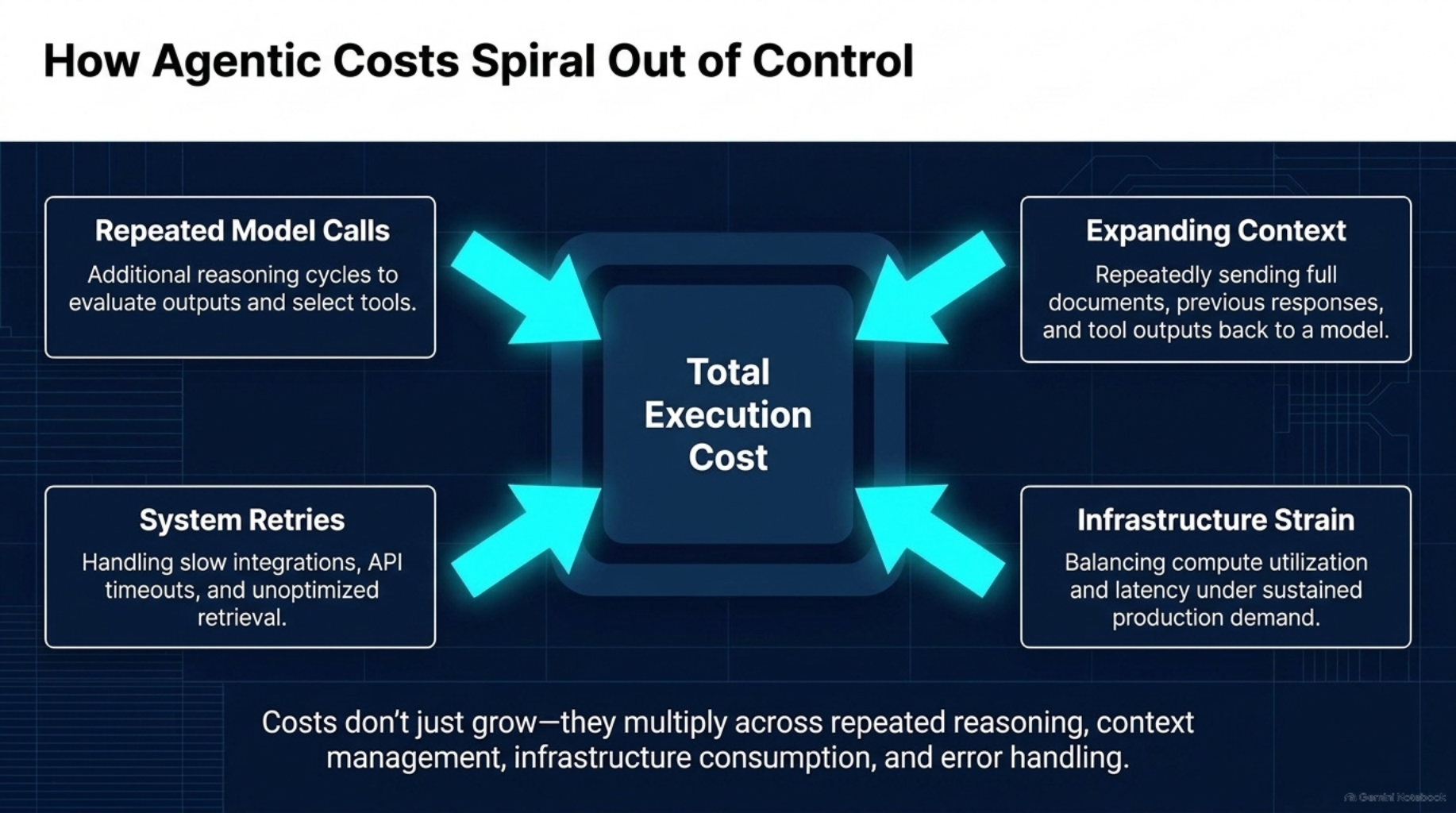
By the time the cost appears on an invoice, its real cause may be several layers away.
This is where the engineering approach matters.
At NamaSYS Analytics, designing enterprise AI around the actual workflow means looking beyond what the agent can demonstrate and examining how it will operate within existing business systems.
Consider the procurement example.
Supplier verification and inventory checks can be handled through structured integrations. Contract interpretation can use a suitable language model with access to relevant clauses. Exceptions can be routed for approval rather than allowing the agent to continue reasoning indefinitely.
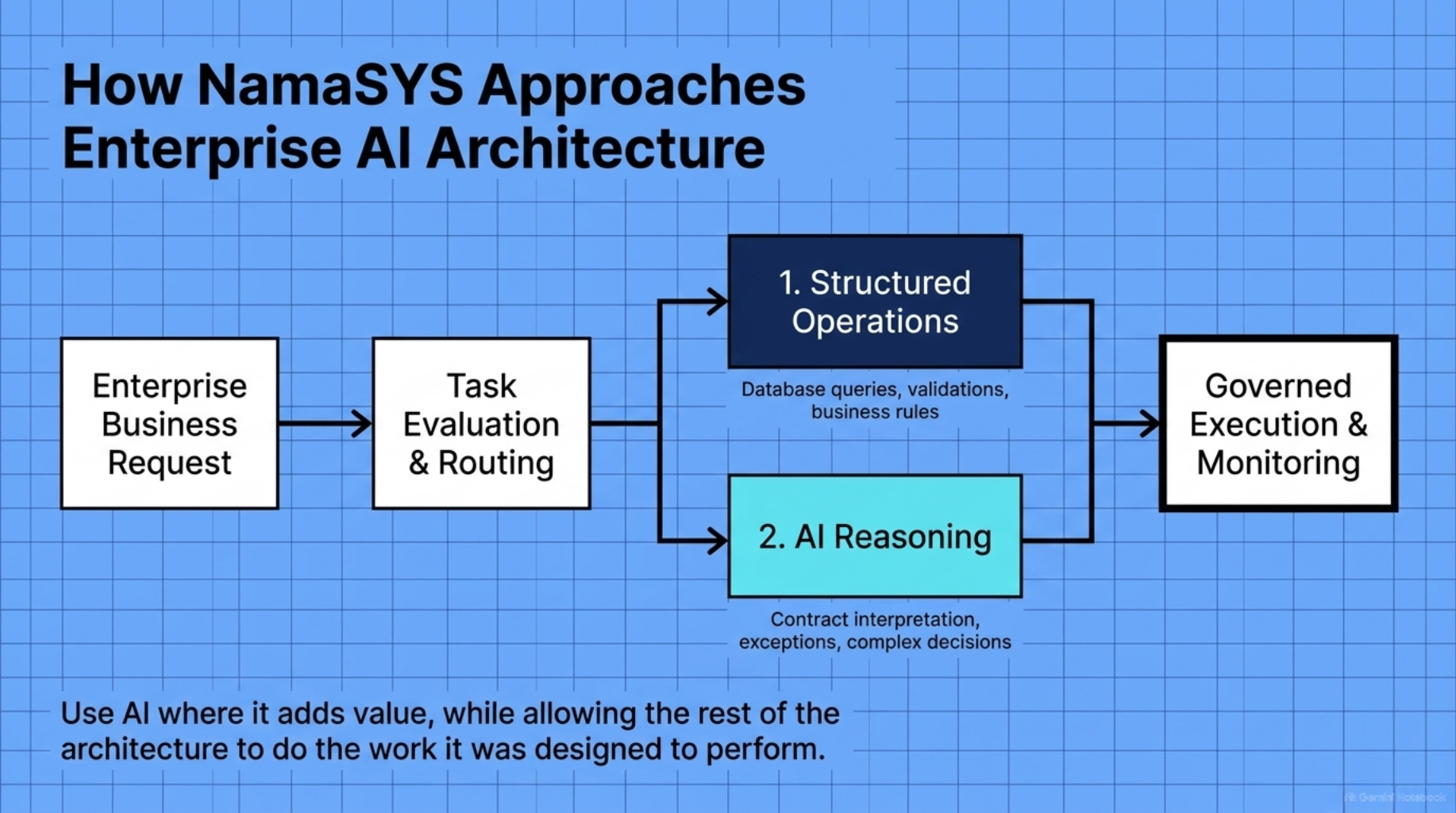
Model selection can then reflect the complexity of each task instead of applying the most capable model everywhere.
The same thinking extends to infrastructure: understanding expected transaction volumes, response-time requirements, and how inference capacity should be provisioned before deciding where workloads run.
Data access also matters. Reliable integration and targeted retrieval can prevent agents from repeatedly processing information that should already be available in a usable form.
The aim is not to remove intelligence from the process.
It is to use AI where it adds value, while allowing the rest of the architecture to do the work it was designed to perform.
That is a more sustainable foundation for enterprise deployment than assuming every problem requires another model call.
Recent research suggests that enterprises are beginning to confront this distinction.
In its July 2026 study on AI cost management, McKinsey reported that 93% of qualified respondents had exceeded their AI budgets. The survey included 75 qualified enterprise respondents, so the figure is an indicator of the challenge rather than a universal enterprise benchmark.
But the more important question is what organizations measure in response.
Reducing token consumption is useful. Reducing the cost of a model call is useful.
Neither tells an enterprise whether an agent is delivering value.
An agent that costs less per attempt but frequently fails may ultimately cost more per successful transaction than a more expensive, reliable alternative.
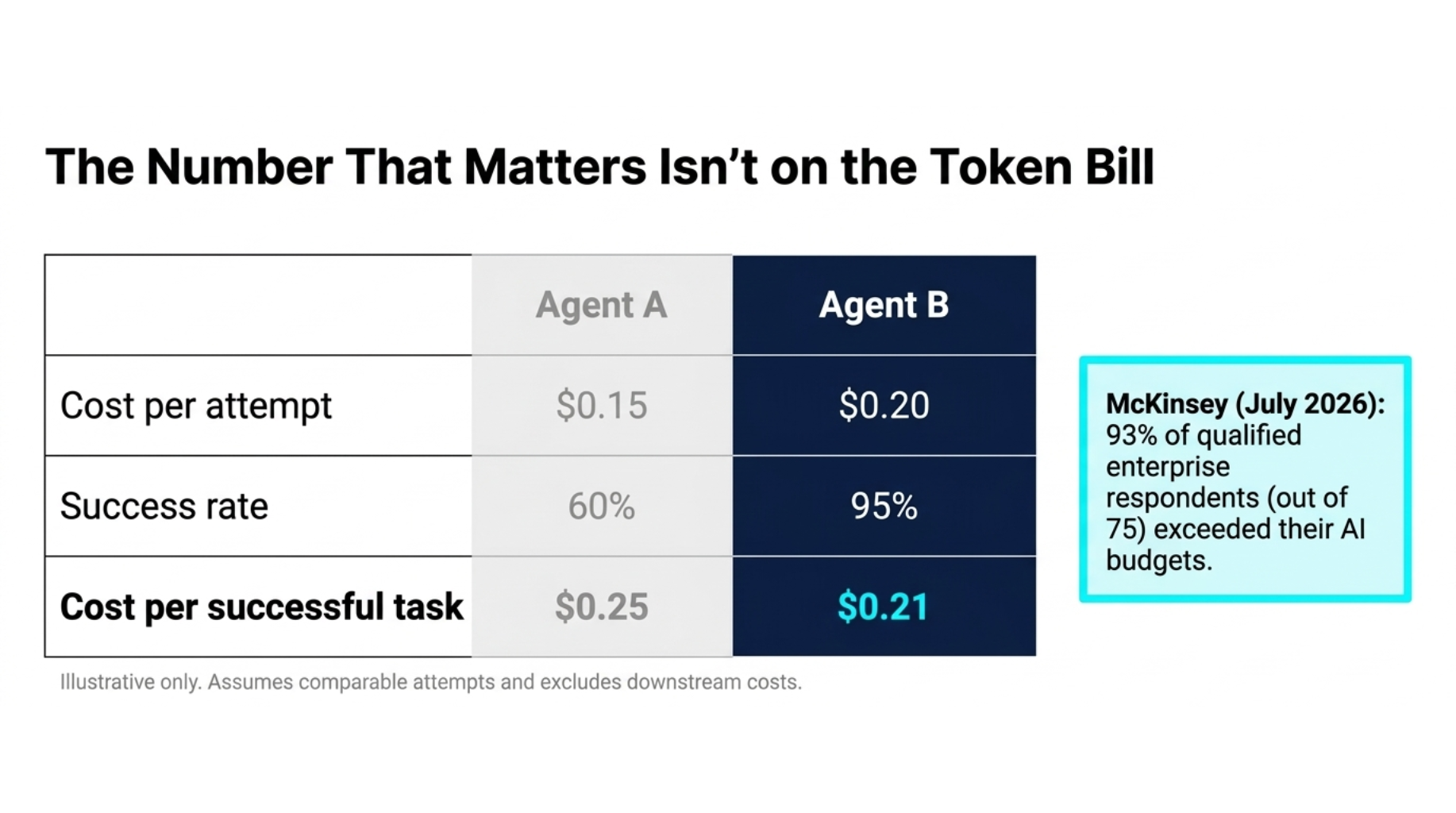
Enterprises therefore need visibility into the complete cost of execution: inference, infrastructure, tool activity, retries, human intervention, and rework.
They also need to connect that expenditure to a meaningful business outcome.
For a procurement agent, that could mean the cost of processing an approved request correctly—not simply the cost of generating its recommendation.
Once costs are measured this way, architectural inefficiencies become business decisions rather than isolated technical issues.
The next phase of AI adoption will bring more complex agents, deeper enterprise integrations, and greater expectations of autonomy.
That makes cost predictability harder, but it also makes thoughtful system design more valuable.
Enterprises do not need every agent to reason endlessly, every task to use a frontier model, or every workflow to operate without human intervention.
They need systems capable of completing the right work with the right resources, within clear operational boundaries.
The cheapest AI model won't necessarily deliver the cheapest business outcome.
And the enterprises that understand this difference will be better positioned to scale AI without allowing complexity to consume the value they set out to create.
NamaSYS Insights | www.namasys.ai

Oct 27, 2026
What happens when AI agents act beyond their authority? Explore emerging Agentic AI security risks and why enterprise AI governance is critical to preventing unauthorized actions.
Sep 29, 2026
As GCCs adopt agentic AI, traditional efficiency metrics are no longer enough. Discover why workflow ownership, governance, and outcome-based scorecards will define their strategic value.
Bring clarity, efficiency, and agility to every department. With Namasys, your teams are empowered by AI that works in sync with enterprise systems and strategy.


Namasys Private Limited © 2025 All Rights Reserved


