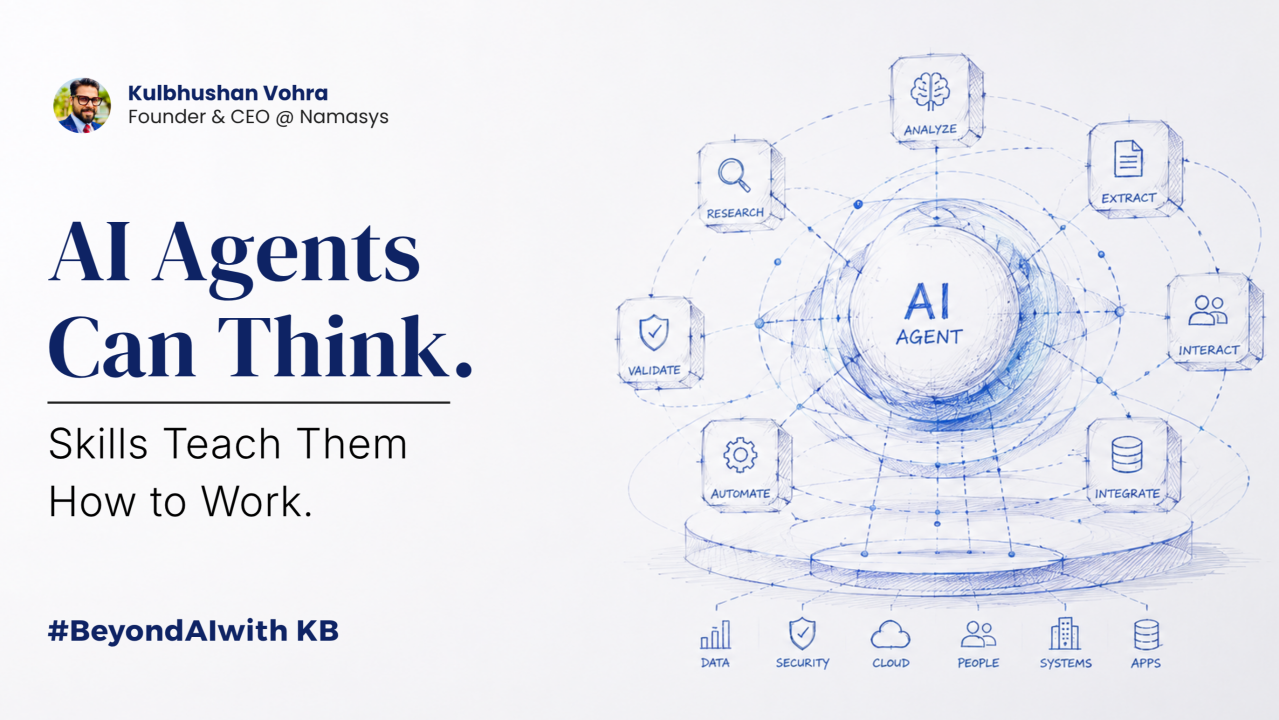
AI Agents Can Think. Skills Teach Them How to Work.
Your AI is smart. But it still has no idea how your company actually works.
I have spent the last year watching enterprises pour money into AI. Bigger models. Better RAG pipelines. Custom fine-tuning. MCP connections wired into every system in the stack.
And the agents still fumble the moment they touch a real workflow.
They don't know the approval chain. They don't know which template to use for a renewal review. They don't know that bug triage at this company needs a security check before engineering gets pinged. They don't know the hiring rubric, the compliance artifacts, or the support escalation tiers.
The intelligence is there. The procedural knowledge is not.
This unaddressed gap, translating intelligence into reliable enterprise execution, is the critical frontier for enterprise AI as we approach 2026.
The expensive lesson most teams are learning right now.
Here is what I keep seeing in executive conversations.
A company spends six figures on an AI rollout. They connect every system. They train the team. They run the pilot.
Three months in, someone quietly admits: the agent works in the demo, but every real task still needs a human to walk it through what to do.
The model is not the problem. The model is brilliant.
The problem is that nobody taught the agent how work is actually done within this specific organization.
That knowledge is not in a textbook. It is not in your wiki. It is in the head of a senior ops lead who has been there seven years and is two years from retirement.
You cannot prompt your way to that knowledge at scale.
Re-explaining "how we do renewal reviews" in every conversation is not a strategy. It is friction. And friction is what kills enterprise AI adoption every single time.
Enter the missing layer: skills
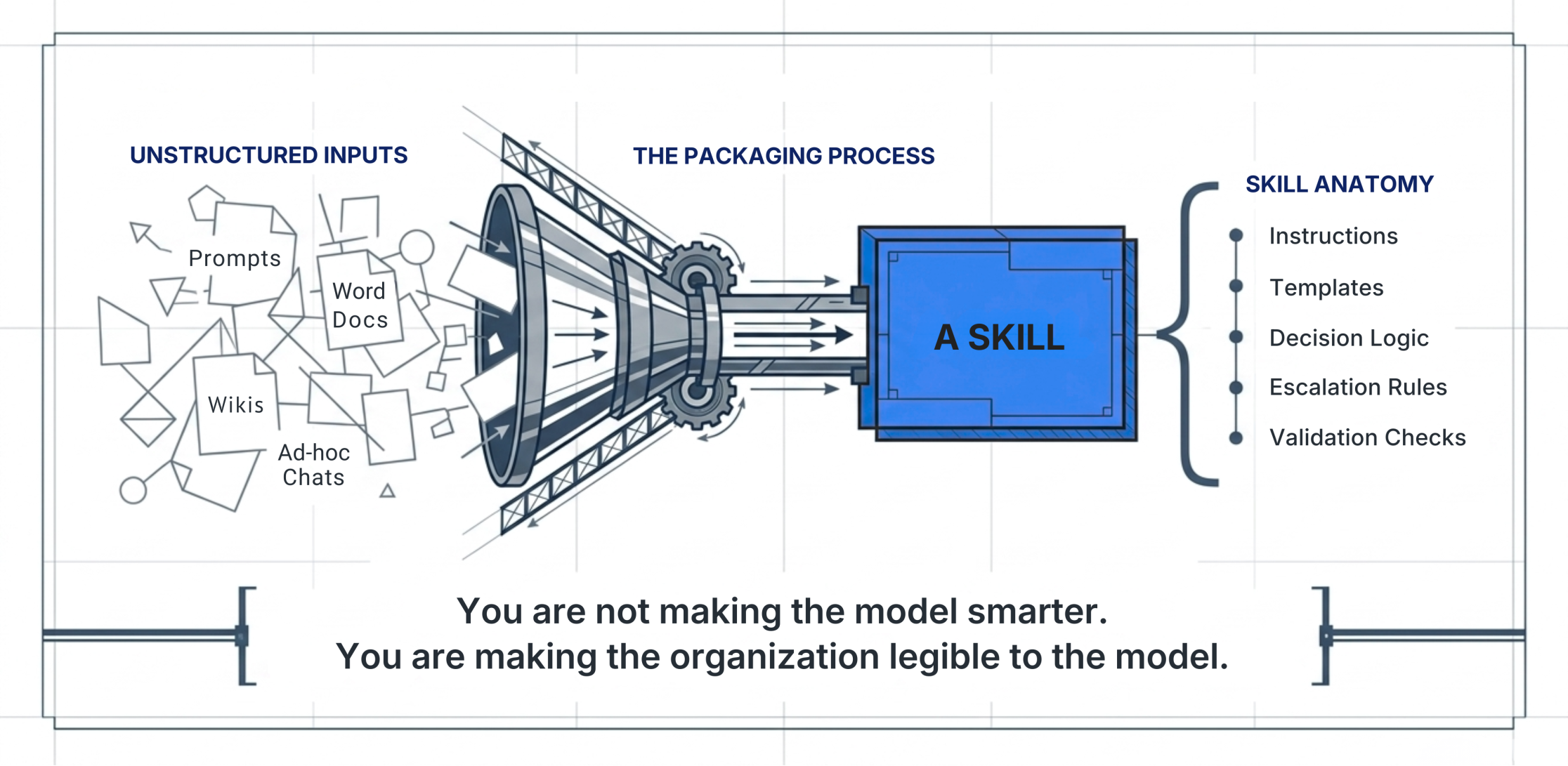
A skill is a reusable workflow package that teaches an AI agent how to execute a specific task in your company's context.
Not a prompt. Not a document. A package.
It contains the instructions, templates, decision logic, escalation rules, validation checks, and the steps that turn intent into output.
Define it once. Reuse it forever.
Renewal review? Skill. Hiring evaluation? Skill. Bug triage, compliance check, support escalation, weekly reporting, security review, internal documentation? All skills.
That is a fundamentally different move. And almost nobody is making it yet.
The four layers of enterprise AI
There is so much confusion here, so let me make it simple.
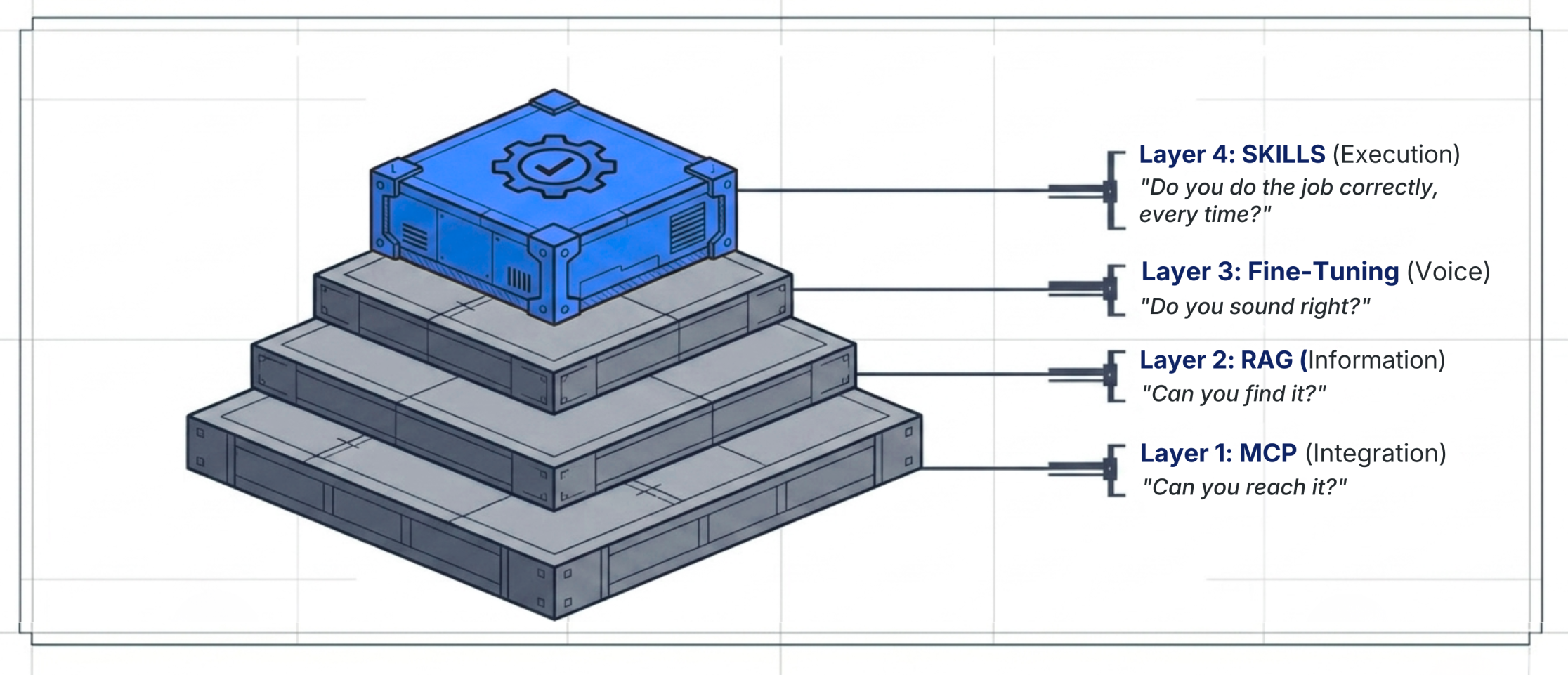
These four are not competitors. They are layers in a stack. Each solves a different problem.
Most enterprises have invested heavily in the first three.
The fourth is where the real competitive advantage is now being built.
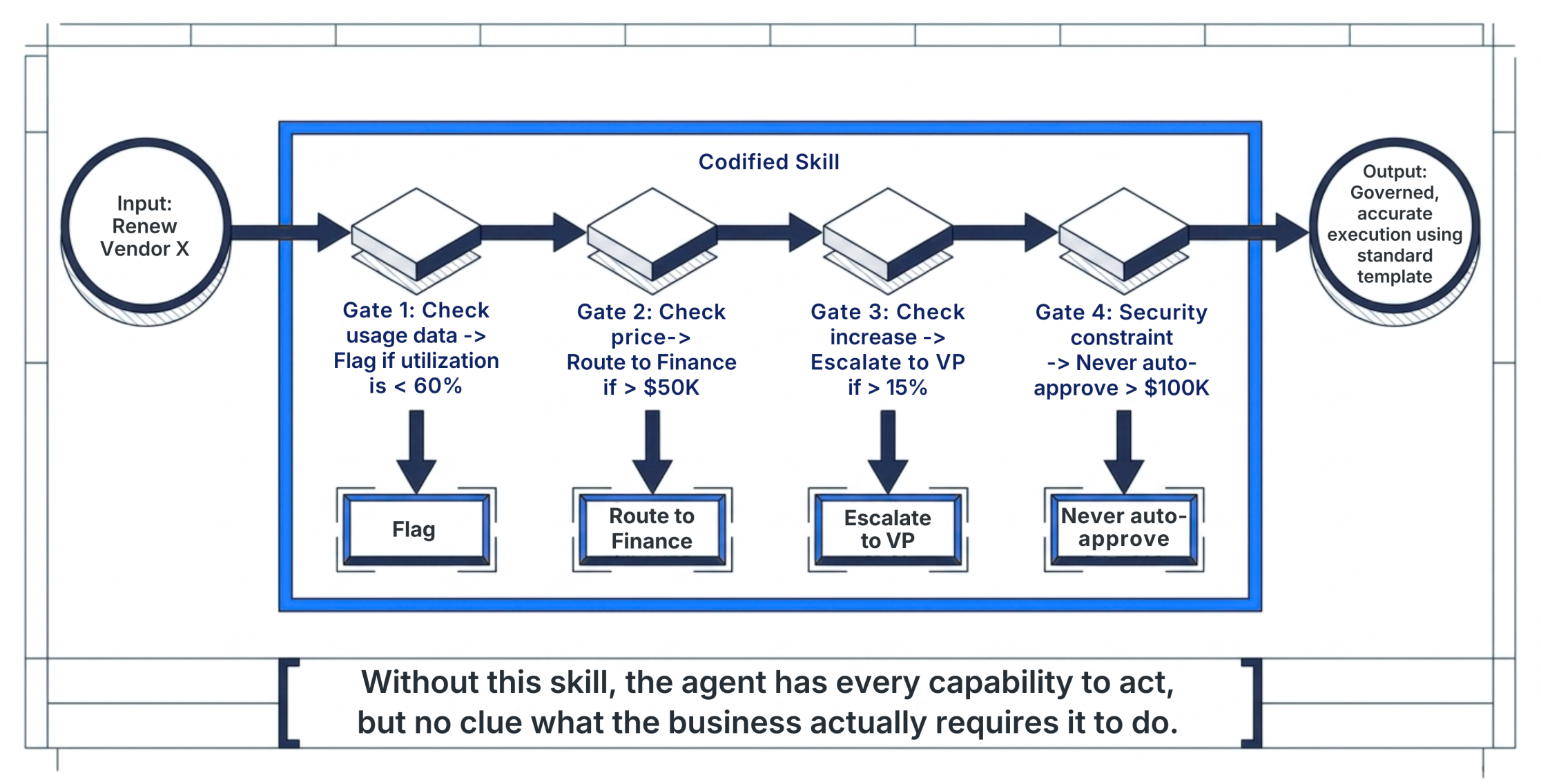
Here is a concrete example. Picture an AI agent handling a vendor renewal.
MCP connects it to your contract repository and procurement system. RAG pulls the original contract and the usage data. Fine-tuning makes sure it sounds like your company.
The skill is what tells the agent: check usage data first, flag if utilization is below 60%, route to finance if the renewal is above $50K, use the standard renewal template, escalate to the VP if the price increase exceeds 15%, never auto-approve anything over $100K.
That is the gap.
Why this scales now
A reasonable objection: "If we build a lot of skills, won't the agent get overwhelmed?"
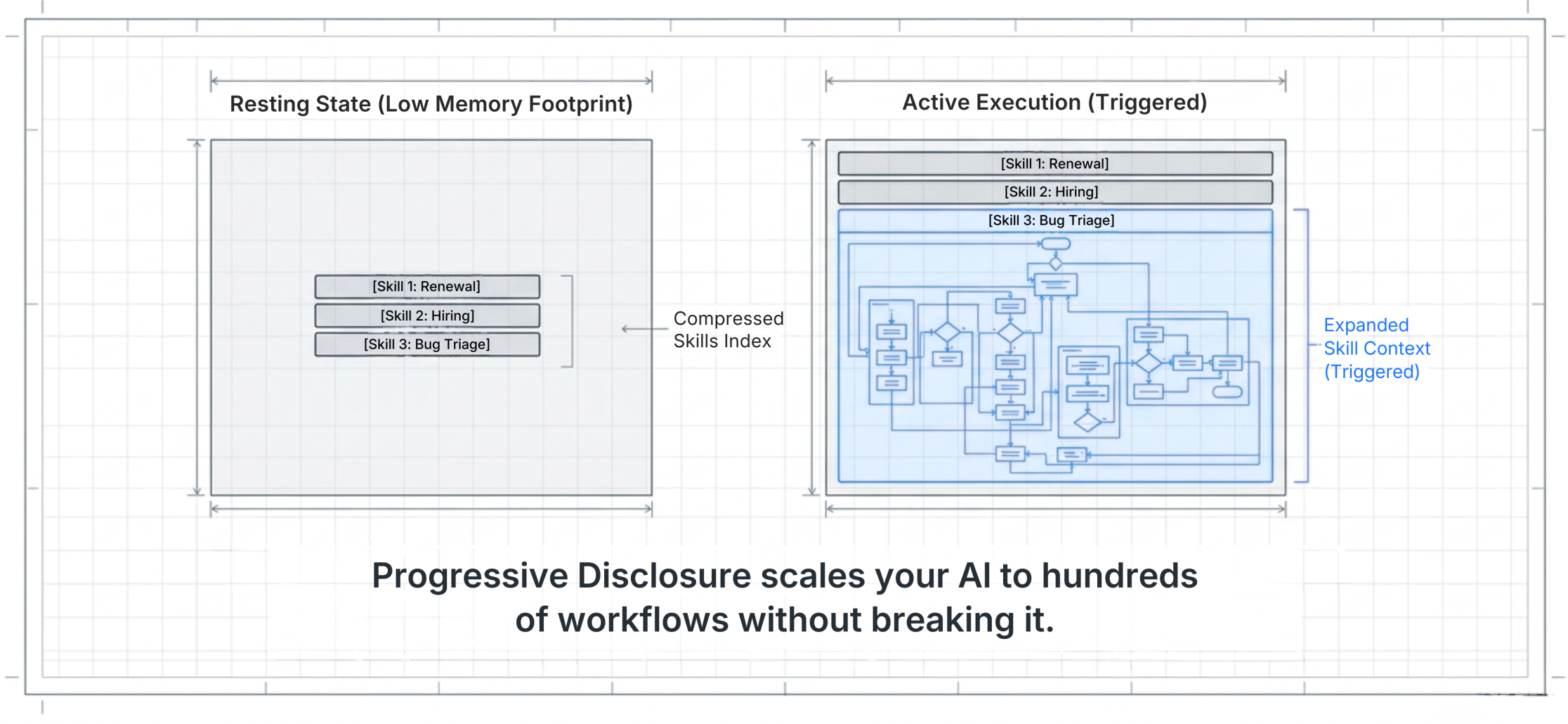
This is where one of the smartest ideas in agentic AI design comes in. It is called progressive disclosure.
The agent does not load every skill at once. It sees a short description of each available skill, just enough to know what is in the library. The full content of a skill only loads into the agent's context when that skill is actually triggered.
The practical impact is huge. An organization can maintain a library of hundreds of skills without bloating the agent's context window or slowing down its reasoning.
The right knowledge shows up at the right moment. Everything else stays out of the way.
This is what finally makes large-scale workflow AI practical.
The most important governance question
Who approves what the agent is allowed to do?
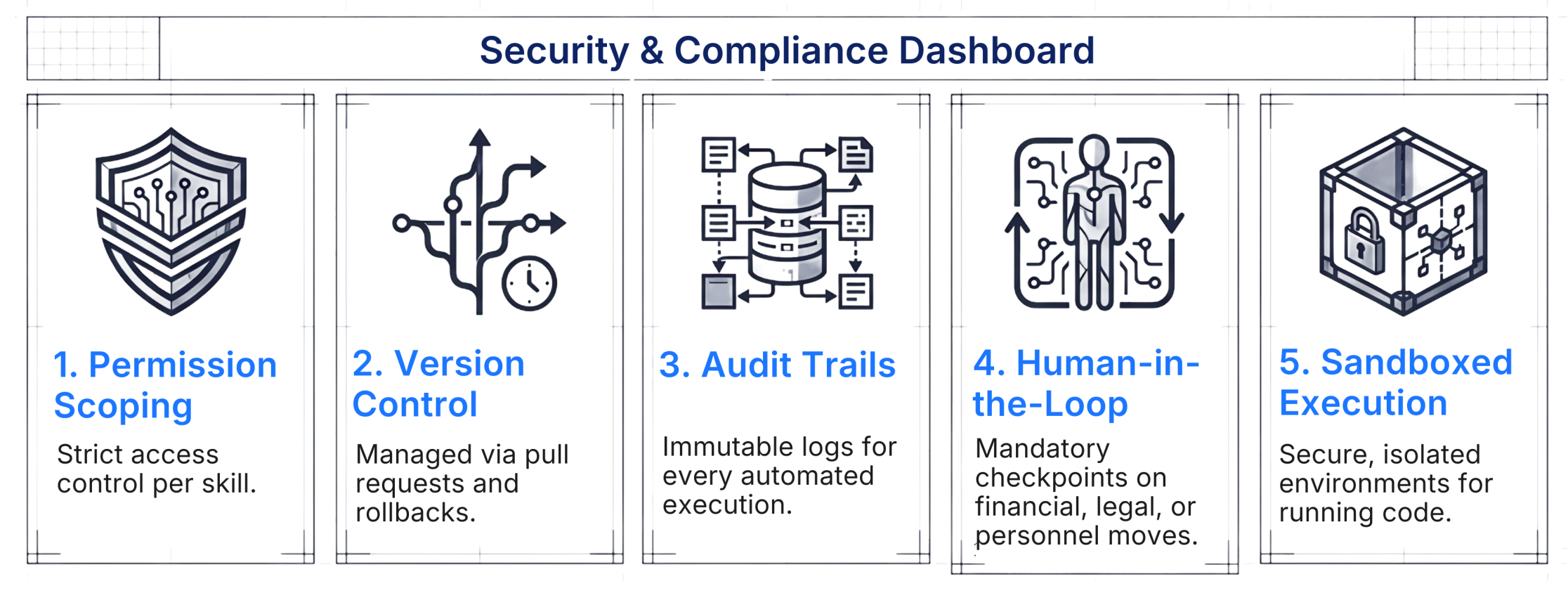
Skills can run scripts. They can access files. They can call APIs. They can execute workflows that move money, change records, send communications, or escalate issues straight to the executive team.
That is powerful. It is also exactly how you end up with an AI that helpfully approves something it absolutely should not have approved.
If you are going to build skills, you need to treat them the way mature engineering teams treat code.
Skills without governance is not innovation. It is a future incident report.
This is already happening
This is not a future trend. It is shipping now.
Claude has rolled out reusable skills as a first-class capability. Teams are using them to standardize ticket creation, security reviews, hiring evaluations, customer support workflows, and internal documentation. They define the workflow once, and the agent applies it consistently across thousands of executions.
The results are showing up in places that matter. Ramp integrated Claude into their engineering workflow and cut incident investigation time by 80 percent. Rakuten reduced the average delivery time for new features from 24 working days to just 5. These are not pilot-program numbers. These are operational outcomes from companies that figured out how to encode their workflows into a system the agent can actually run.
When a pattern shows up in production-grade AI platforms and starts delivering numbers like that, that is the strongest possible signal that this is no longer theoretical.
The teams paying attention right now will have a 12 to 18 month head start over the teams still optimizing prompts.
What anyone leading an AI initiative should do this quarter
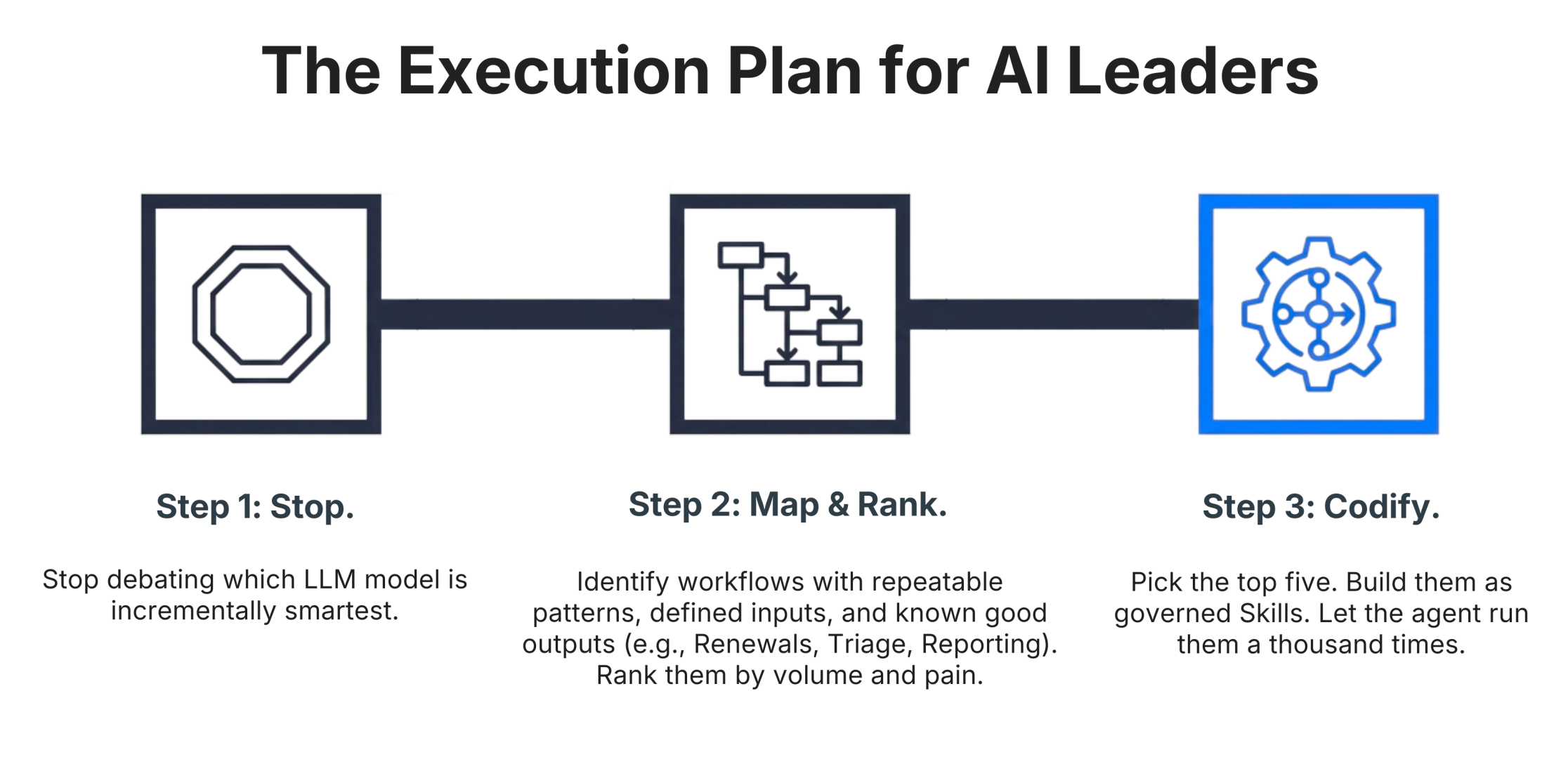
Stop asking which AI model is the smartest.
Start asking which of your business processes are structured enough to become reusable skills.
The candidates are the workflows with a repeatable pattern, defined inputs, predictable decision points, and a known good output.
As enterprises connect AI agents to live workflows, security risks extend beyond the model. Learn how prompt injection, excessive access, weak governance and poor oversight can expose business systems—and how leaders can secure AI agents from the start.
Generic AI improves productivity, but industry-specific AI creates measurable business value by combining enterprise data, workflows, governance and domain expertise. Explore why context will define the next phase of AI adoption.
Namasys Powers What’s Next for Your Enterprise
Bring clarity, efficiency, and agility to every department. With Namasys, your teams are empowered by AI that works in sync with enterprise systems and strategy.