Why AI Adoption Is Rising but Business Value Is Still Missing
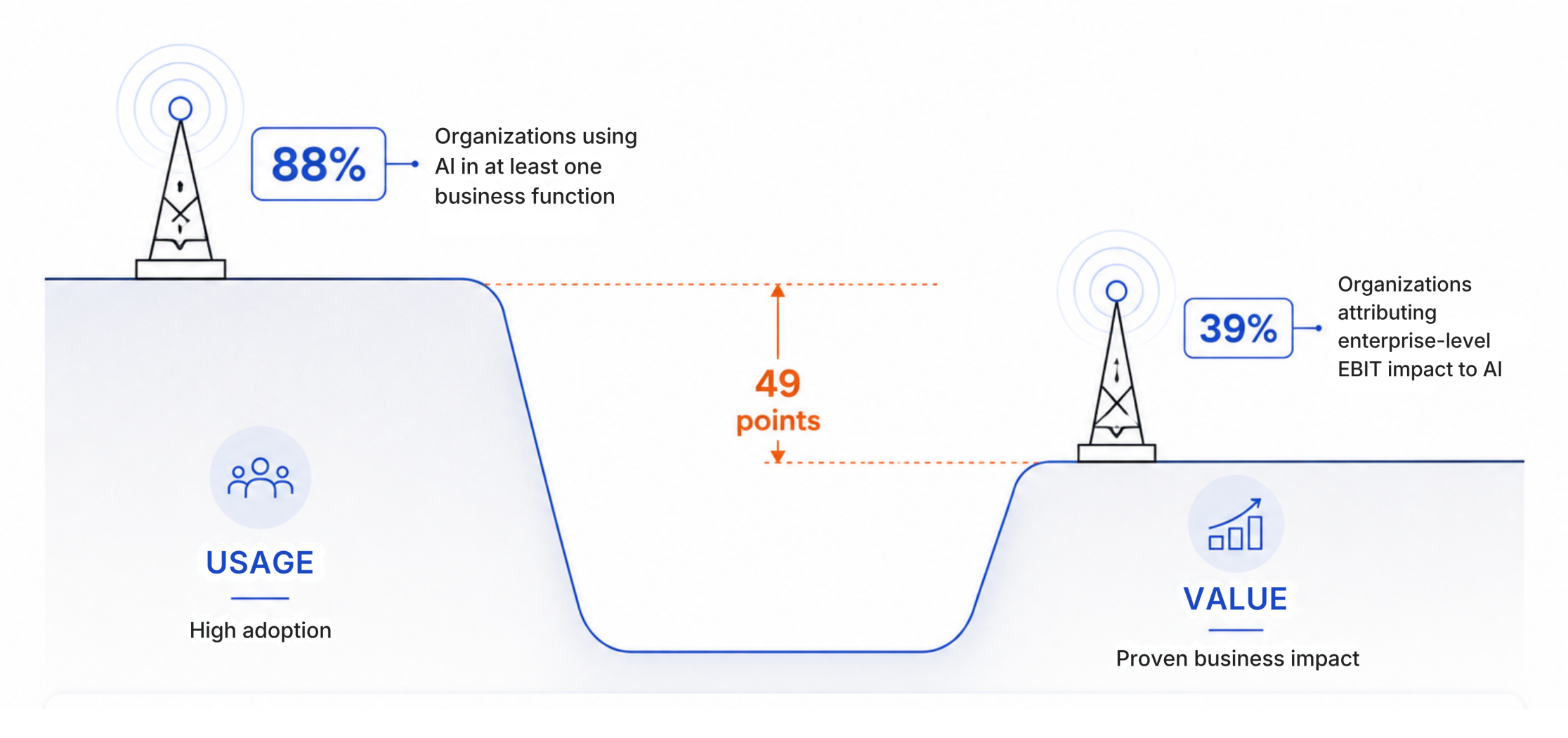
88% of organizations say they are using AI in at least one business function.
Only 39% can attribute enterprise-level EBIT impact to AI.
That 49-point gap is the real AI story in 2025. Not the tools. Not the pilots. Not the announcements.
The leadership question has changed.
It used to be: are we using AI? Most leadership teams can now say yes. The harder question — the one that actually matters, is what business performance has AI improved?
For most organizations, that answer is unclear. Not because AI doesn't work. Because AI was deployed before the organization was ready to convert it into value.
This is the AI value gap, and it is widening.
Why Pilots Do Not Become Performance
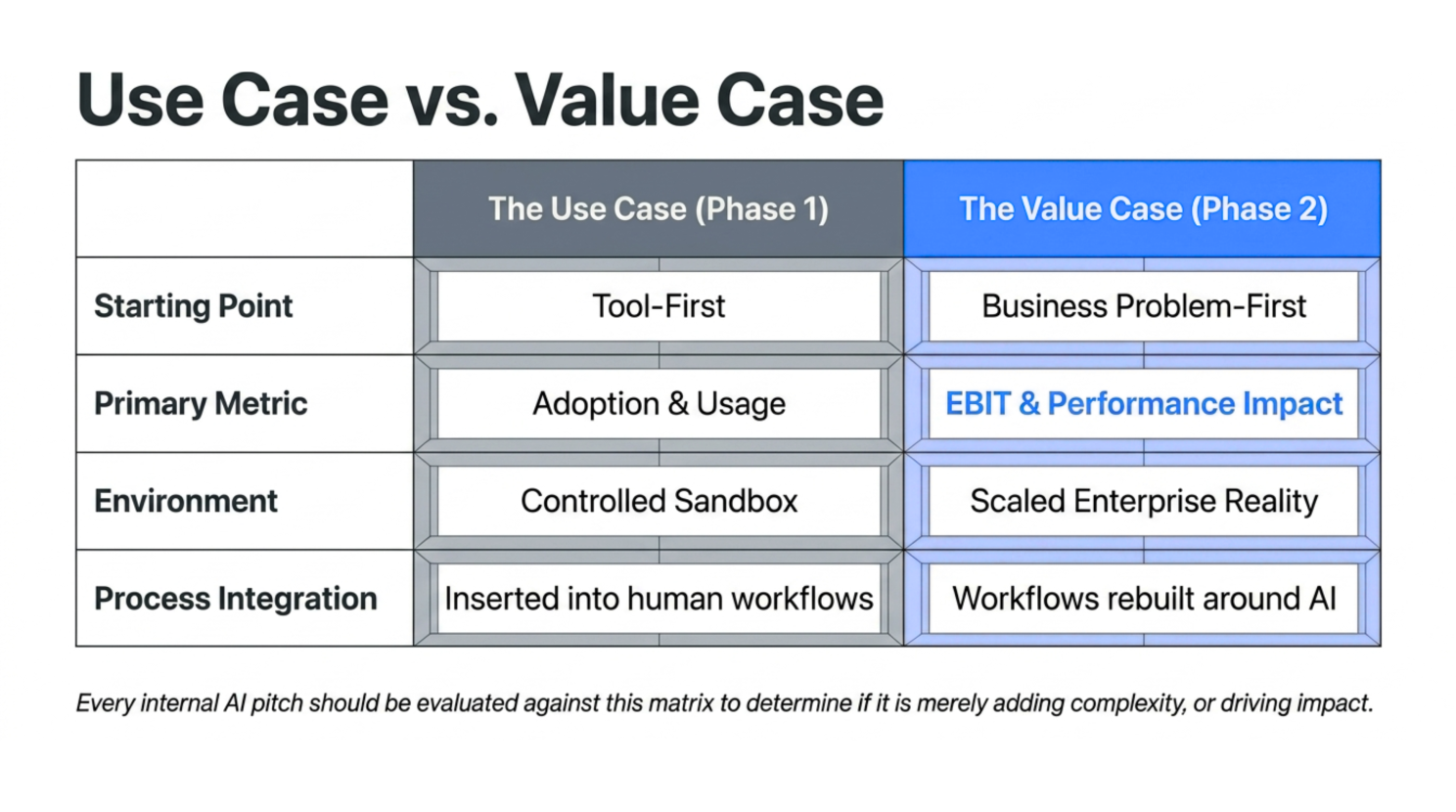
AI initiatives typically start with the tool, not the problem.
Teams evaluate platforms. Departments test use cases. Leadership tracks usage metrics.
None of that is wrong. But none of it is sufficient.
A pilot can work in a controlled environment.
Scaling it across departments, data systems, approval structures, risk controls, and people behaviors is a different challenge.
That is where many enterprise AI programs stall.
The issue is not technology readiness. It is organizational readiness.
Five Foundations That Decide Whether AI Creates Business Value
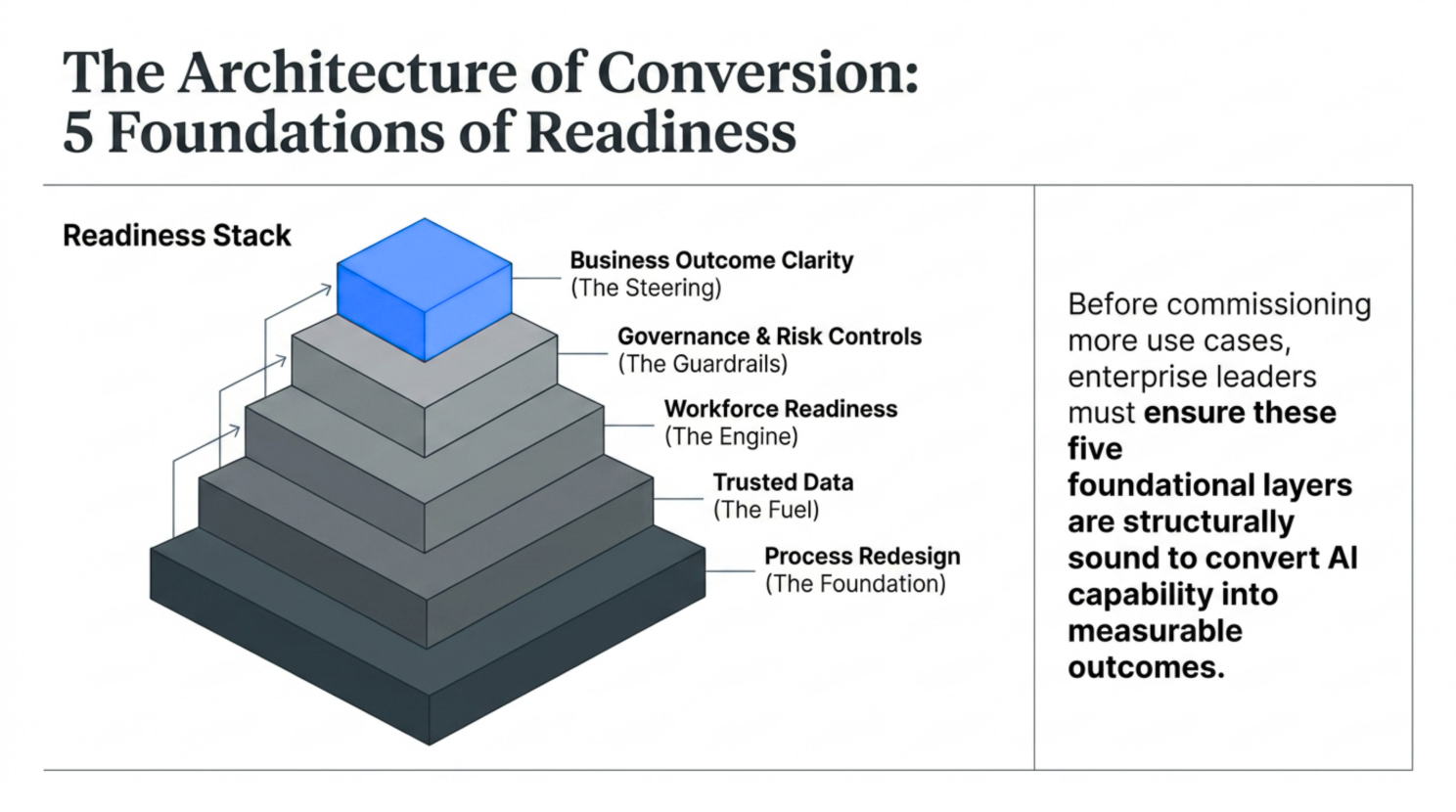
Before commissioning more use cases, leaders should check whether the business can actually convert AI capability into measurable outcomes.
Five foundations matter most.
1. Business Outcome Clarity
Every AI initiative should be anchored to a specific business metric.
Customer response time.
Sales conversion rate.
Forecast accuracy.
Risk detection.
Operational downtime.
Decision quality.
When the link between an AI initiative and a business number is absent, leaders cannot measure it, prioritize it, or scale it.
The question before any AI investment is simple:
Which number will this move?
2. Trusted Data
AI generates outputs quickly.
The reliability of those outputs depends entirely on the inputs.
Many organizations are still running on disconnected systems, inconsistent records, manual reporting, and unclear data ownership.
For banking, insurance, logistics, healthcare, manufacturing, and infrastructure businesses, data readiness is not an IT consideration.
It is a business requirement.
3. Governance and Risk Controls
AI is now a decision support layer inside the organization. That requires clear rules.
Where can AI assist?
Where can AI act?
Where must human judgement stay in control?
As organizations move from AI assistants to AI agents, systems that can support multi-step workflows, monitor patterns, and coordinate work across platforms, the governance stakes increase materially.
Someone needs to own that.
4. Workforce Readiness
Employees are already using AI, often ahead of any formal guidance.
The training gap is not only about tools or prompts. It is about judgement.
People need to know when to trust an AI output, when to verify it, how to protect confidential data, and how to combine machine intelligence with human decision-making.
Without that, AI introduces new risks alongside new capabilities.
5. Process Redesign
This is the foundation most organizations underinvest in.
AI creates value when processes are rebuilt around what AI makes possible, not when AI is inserted into processes designed for human-only execution.
If analysis that took three days now takes three hours, the decision process needs to change to capture that advantage.
Productivity gains only convert to business results when the work is redesigned around them.
What Leadership Needs to Own
AI sits at the intersection of business strategy, operations, data, people, and governance.
The CXOs, and business heads all have a role. But the CEO sets the standard.
The first phase of enterprise AI was measured by adoption. The next phase will be measured by impact.
The right question now is not how many teams are using AI. It is which business metrics have improved because of it.
Stop asking teams for more AI use cases and start asking for AI value cases.
Every AI initiative should prove which business metric it improves, revenue, cost, risk, productivity, customer experience, or decision quality.
Without that link, AI only adds activity, complexity, and cost without measurable impact.
The leaders who pull ahead will be the ones who turn AI from organizational activity into measurable business performance.
Sources: McKinsey, The State of AI: Global Survey 2025; Microsoft, Work Trend Index 2026.
As enterprises connect AI agents to live workflows, security risks extend beyond the model. Learn how prompt injection, excessive access, weak governance and poor oversight can expose business systems—and how leaders can secure AI agents from the start.
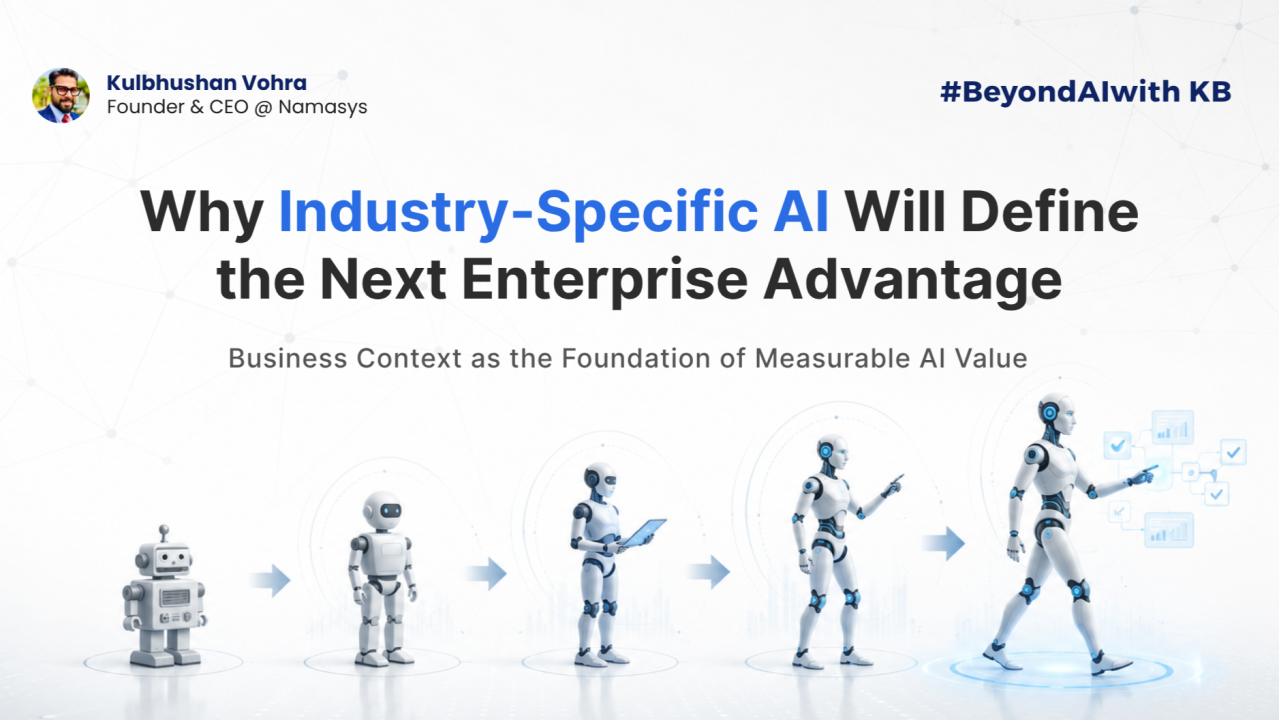
Generic AI improves productivity, but industry-specific AI creates measurable business value by combining enterprise data, workflows, governance and domain expertise. Explore why context will define the next phase of AI adoption.
Namasys Powers What’s Next for Your Enterprise
Bring clarity, efficiency, and agility to every department. With Namasys, your teams are empowered by AI that works in sync with enterprise systems and strategy.