Is AI in HR an Efficiency Tool or Your Next Competitive Advantage?
AI in HR is no longer a pilot initiative. It is becoming an enterprise infrastructure.
Boards are paying attention for a simple reason: workforce decisions are now being shaped by systems that can materially influence hiring quality, retention risk, and productivity, at scale.
The leadership question has shifted:
Are you using AI to automate HR tasks, or to build workforce intelligence, a measurable decision layer across the talent lifecycle?
Where AI Is Actually Being Used Today
The strongest adoption is happening in recruiting.
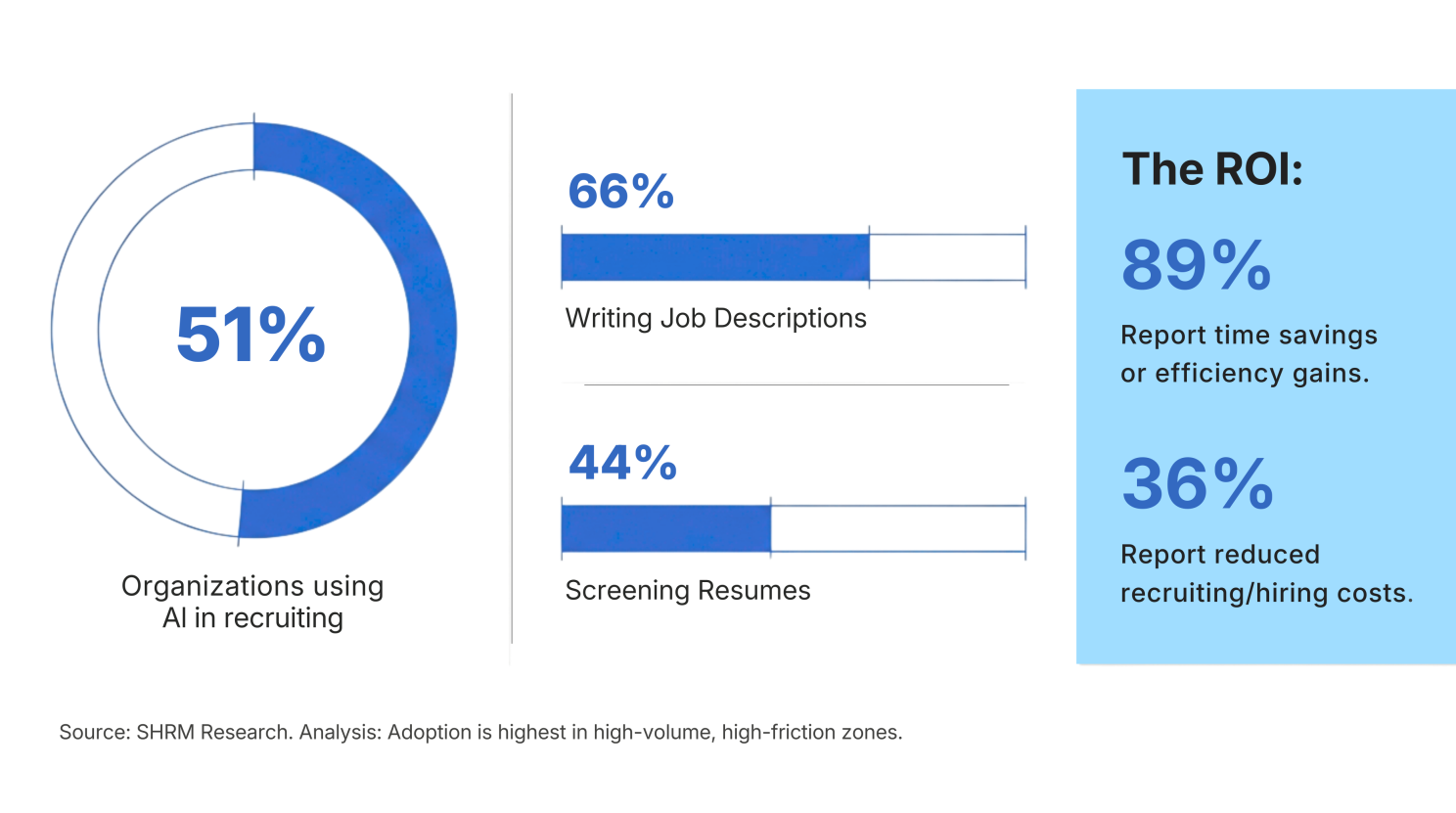
SHRM’s research shows that just over half of organizations (51%) use AI to support recruiting efforts, with the most common applications being writing job descriptions (66%) and screening resumes (44%).
And among HR teams using AI in recruiting, 89% report time savings or efficiency gains, while 36% report reduced recruiting/interviewing/hiring costs.
This is the real signal: AI is moving first into high-volume, high-friction processes, where speed and consistency matter, and where measurable workflow ROI appears quickly.
From Workflow Automation to Decision Intelligence
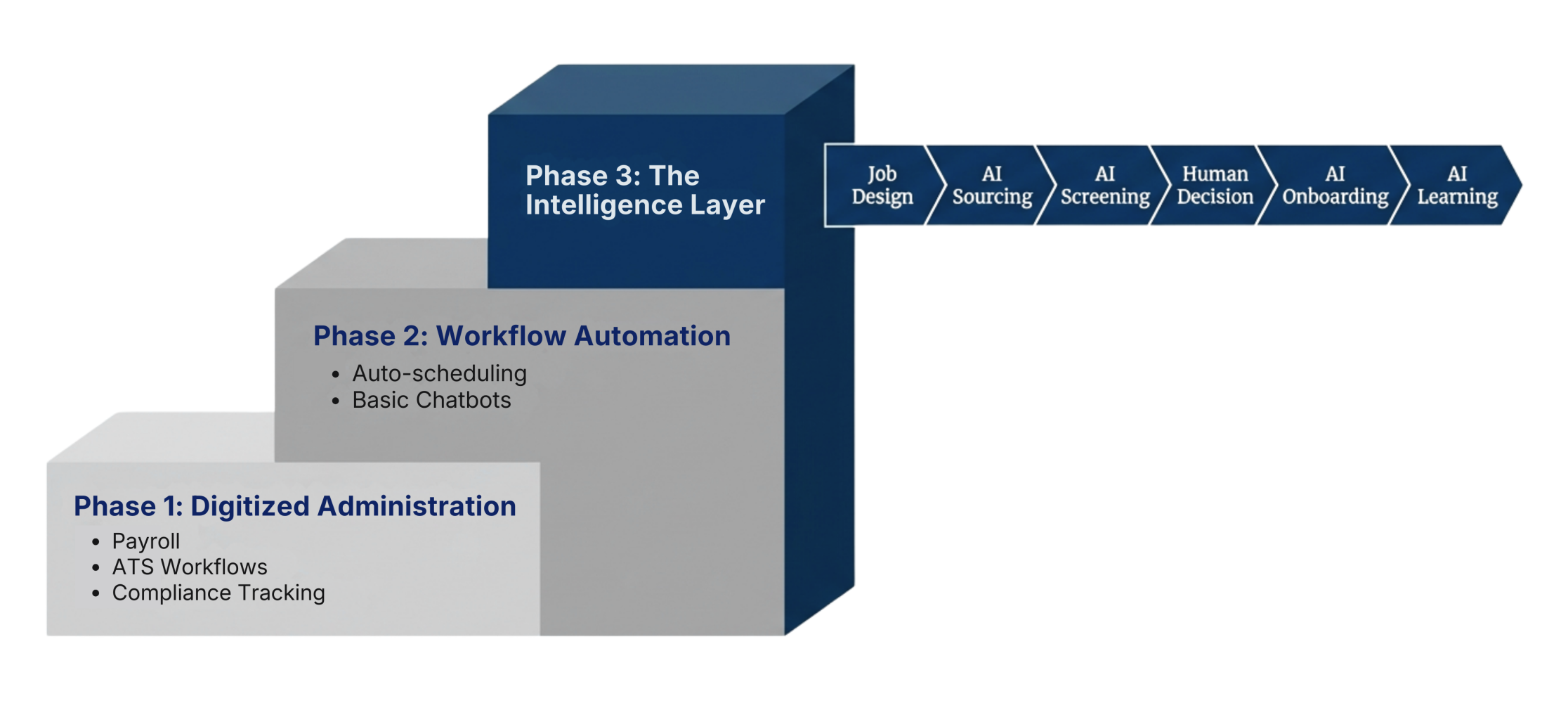
Traditional HR tech digitized administration: payroll, ATS workflows, compliance tracking.
Modern AI introduces an intelligence layer across the lifecycle:
Job Design → AI Sourcing → AI Screening → Human Decision → AI Onboarding → AI Learning → AI Performance Signals
The shift is structural: from “process completion” to decision quality.
IBM’s Institute for Business Value projects AI-enabled HR can drive material performance improvements, 35% productivity uplift and 30% improvement in training effectiveness (with retention also improving in their projections).
That’s why this is becoming board-level: it’s no longer about HR efficiency. It’s about operating leverage.
The Advantage Belongs to the Governed
As HR AI becomes embedded in hiring and workforce decisions, regulatory and compliance expectations rise.
Under the EU AI Act, AI systems used in employment, workers’ management, and access to self-employment are explicitly treated as high-risk, given their impact on livelihoods and fundamental rights, requiring controls such as human oversight and risk management.
The message is clear:
AI advantage without governance becomes liability.
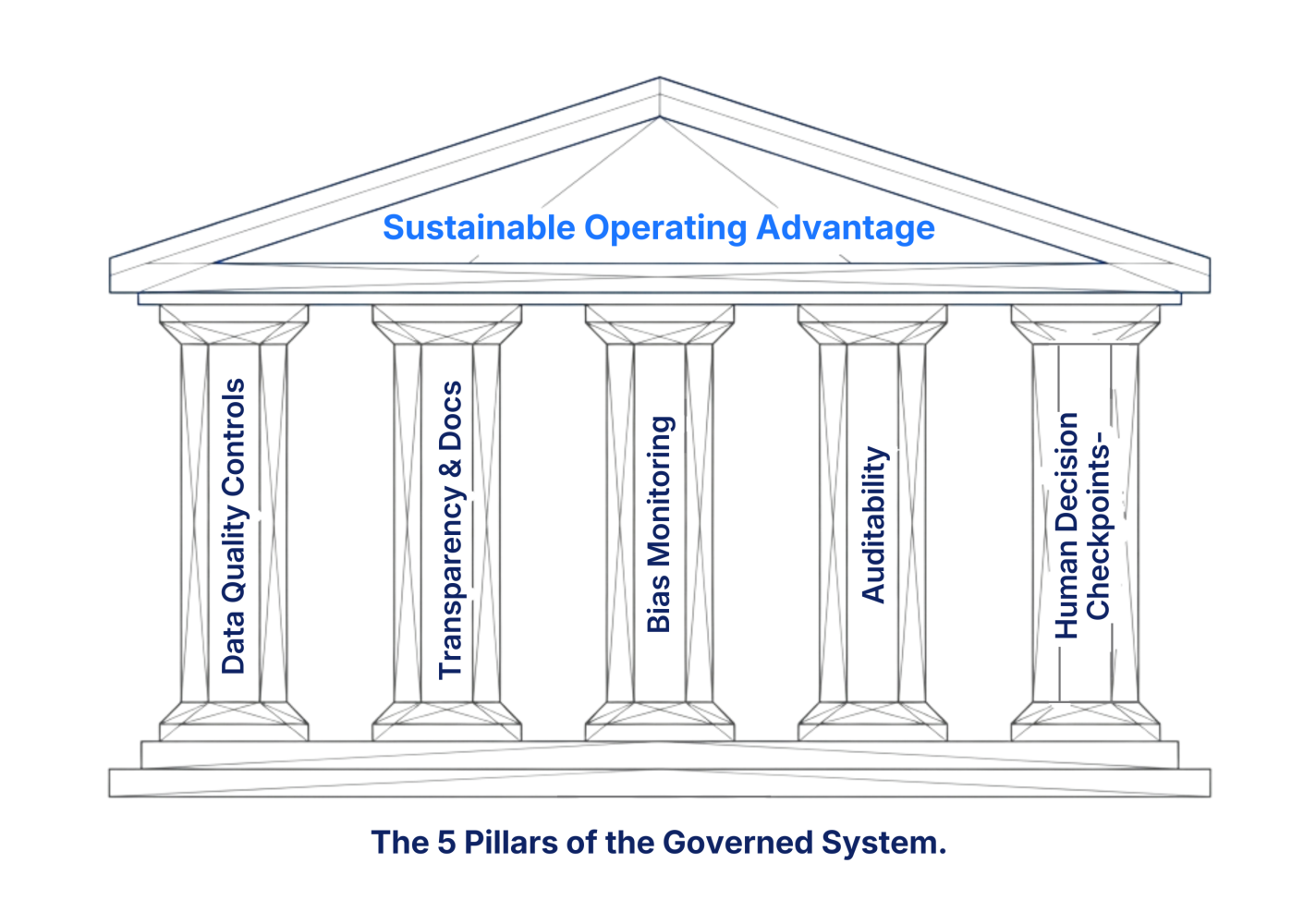
And governance is not paperwork. It is operating design:
Human-in-the-Loop Is Not Optional, It’s Strategic
The most robust academic research doesn’t frame this as “AI replaces HR.” It frames it as a socio-technical system, where outcomes depend on design, oversight, and data.
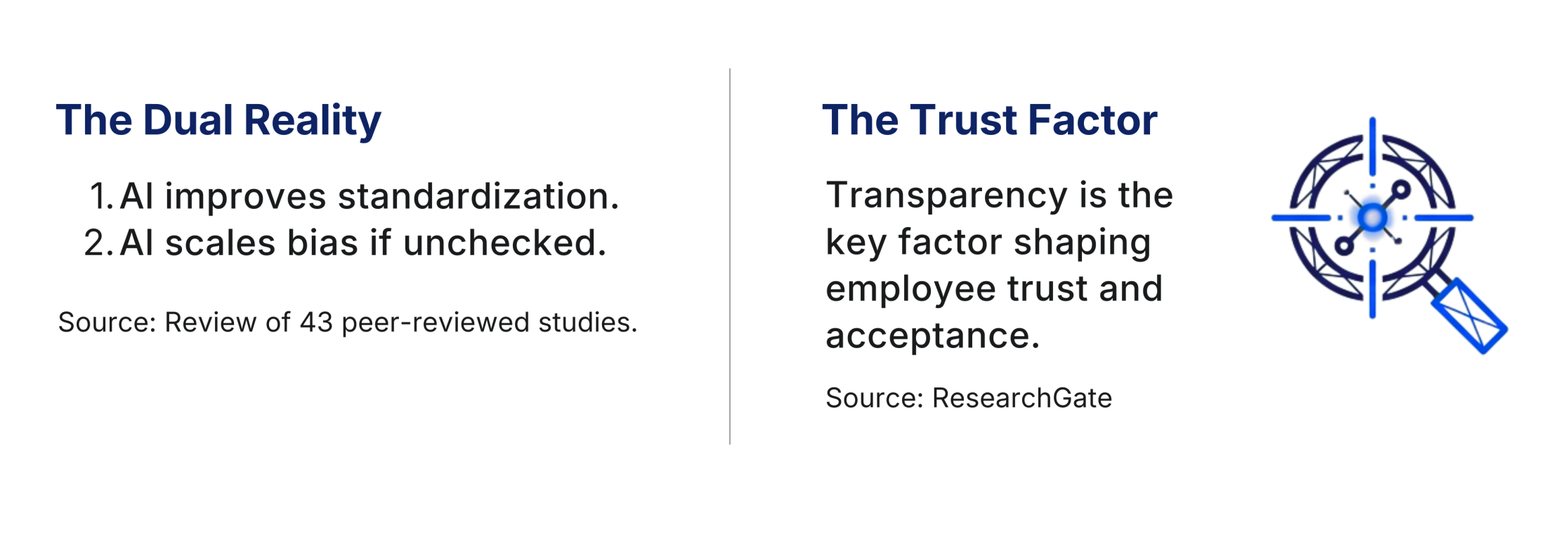
A major 2026 systematic review in Management Review Quarterly synthesizing 43 peer-reviewed studies highlights the dual reality: AI can improve standardization and reduce some human subjectivity, but can also scale bias and reduce accountability if transparency and oversight are weak.
And employee trust is now a frontline variable.
Research on employee well-being and AI in HR points to transparency as a key factor shaping trust, satisfaction, and acceptance, especially when AI is involved in evaluation and decision-making.
Bottom line: sustainable HR AI is augmentation, not autonomy.
Strategic Outlook: Generative AI and Workforce Architecture
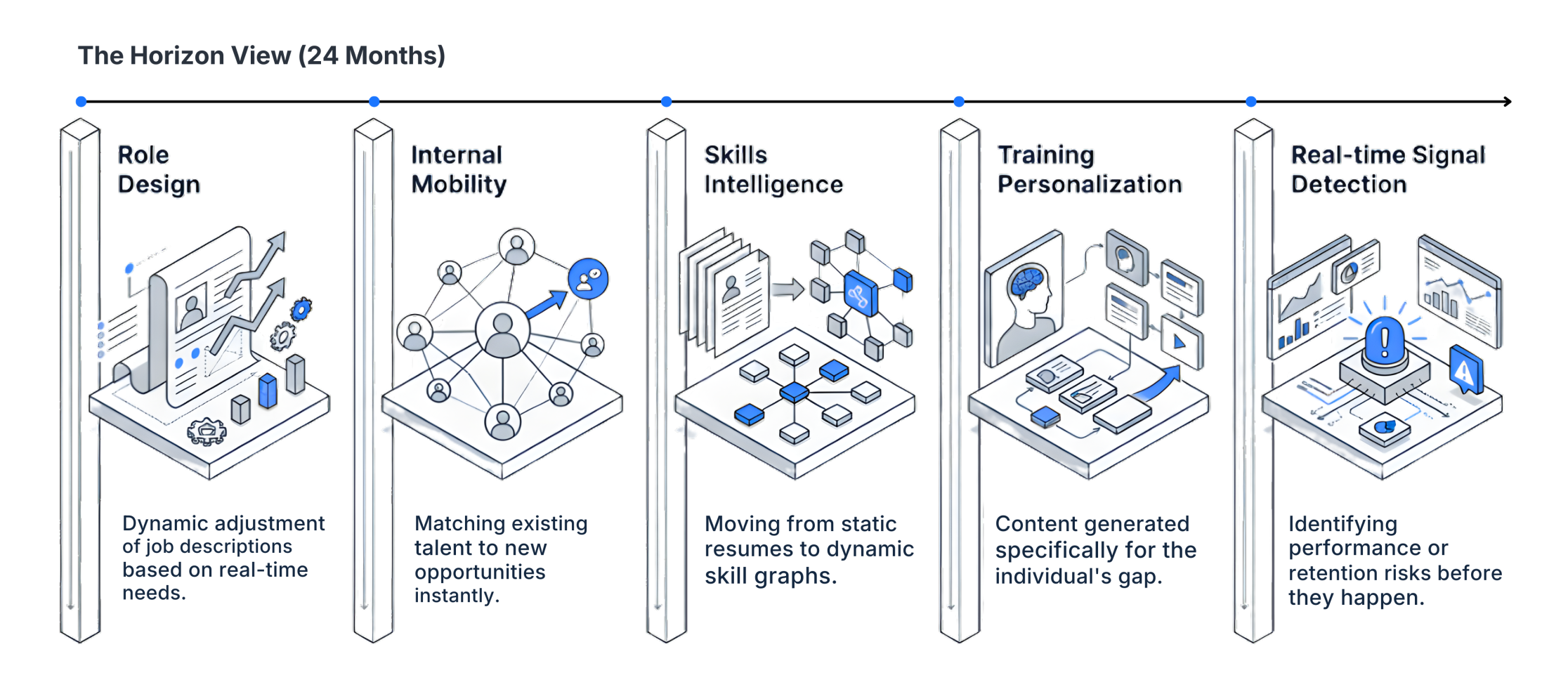
Over the next 24 months, GenAI will increasingly influence:
job and role design
Internal Mobility
Skills Intelligence
Training Personalization
Real Time Signal Detection
But the winners won’t be the ones who “deploy tools.” They’ll be the ones who build decision infrastructure:
measurable outcomes
governed data flows
clear accountability
human-in-the-loop checkpoints
ongoing monitoring
That’s how HR becomes a competitive system, not an administrative function with AI add-ons.
Our Approach
Namasys Analytics understands your business objectives and align AI with the outcomes that matter most to you.
We design governed, scalable AI systems that convert workforce data into measurable decision intelligence, so HR becomes part of enterprise operating advantage.
Because workforce intelligence is not an HR upgrade. It is an enterprise capability.
As enterprises connect AI agents to live workflows, security risks extend beyond the model. Learn how prompt injection, excessive access, weak governance and poor oversight can expose business systems—and how leaders can secure AI agents from the start.
Generic AI improves productivity, but industry-specific AI creates measurable business value by combining enterprise data, workflows, governance and domain expertise. Explore why context will define the next phase of AI adoption.
Namasys Powers What’s Next for Your Enterprise
Bring clarity, efficiency, and agility to every department. With Namasys, your teams are empowered by AI that works in sync with enterprise systems and strategy.