When Intelligence Becomes Commoditized, Decision-Making Is Your Only Edge
In Jensen Huang’s recent interview, there was a moment that may seem minor at first glance, but it fundamentally reframes how leaders and organizations should think about AI.
He frames AI as already transforming work, with systems not only retrieving information but generating, reasoning, and acting in context.
That shift sounds technological. But it's not.
It is a shift in how decisions are made.
For decades, enterprises relied on a model where data is interpreted by people, with decisions happening through layered review, and even digital transformation has left this model mostly intact.
AI does not improve that structure. It starts to replace it.
When systems can reason, evaluate options, and generate outcomes, decision-making no longer needs to rest solely with individuals or committees. It begins to move into systems.
This is where most organizations are getting it wrong.
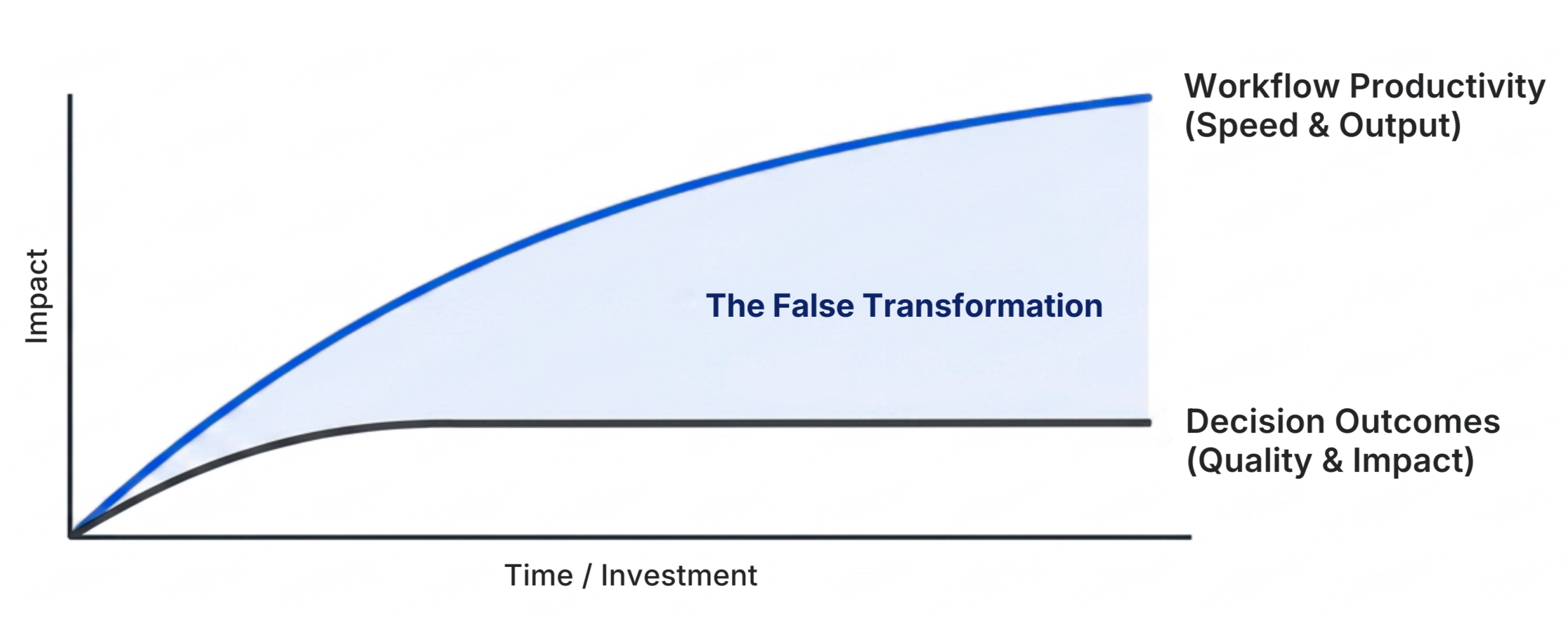
They are investing in AI tools, copilots, and automation layers, expecting transformation. What they are actually doing is making existing workflows faster without changing how decisions are made.
That is why many AI initiatives plateau. Productivity improves, but outcomes don’t change proportionally.
The real shift begins when you stop thinking about AI as a tool and start treating it as part of your decision architecture.
Huang also points to something that will accelerate this shift further. Today, AI is expensive, especially for reasoning models. But that cost will not remain a constraint. Efficiency will improve, models will get smarter, and over time, the cost of intelligence will drop.
When that happens, execution becomes easy.
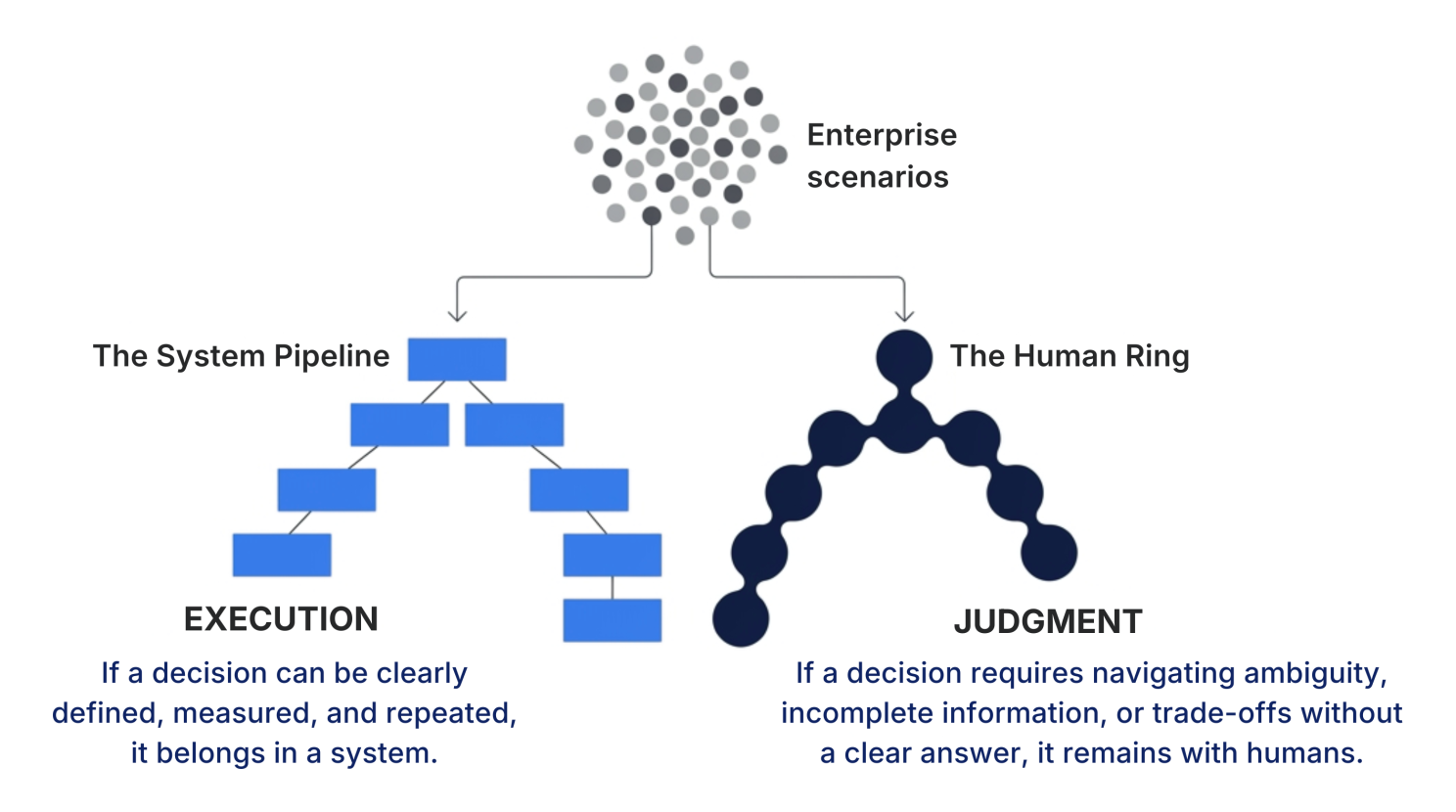
Anything that can be clearly defined, structured, and repeated can be handled by a system. Faster than humans, more consistently, and at scale.
At that point, execution is no longer a differentiator.
What remains is judgment.
The role of leadership, then, is not to hold on to decisions, but to continuously decide which ones should move into systems, and which ones should not.
This is where Huang introduces the idea of “pathfinding.” The ability to operate in ambiguity, to navigate situations where there is no clear answer, no defined process, and no established playbook.
That becomes the real competitive advantage.
And it also changes what leadership means.
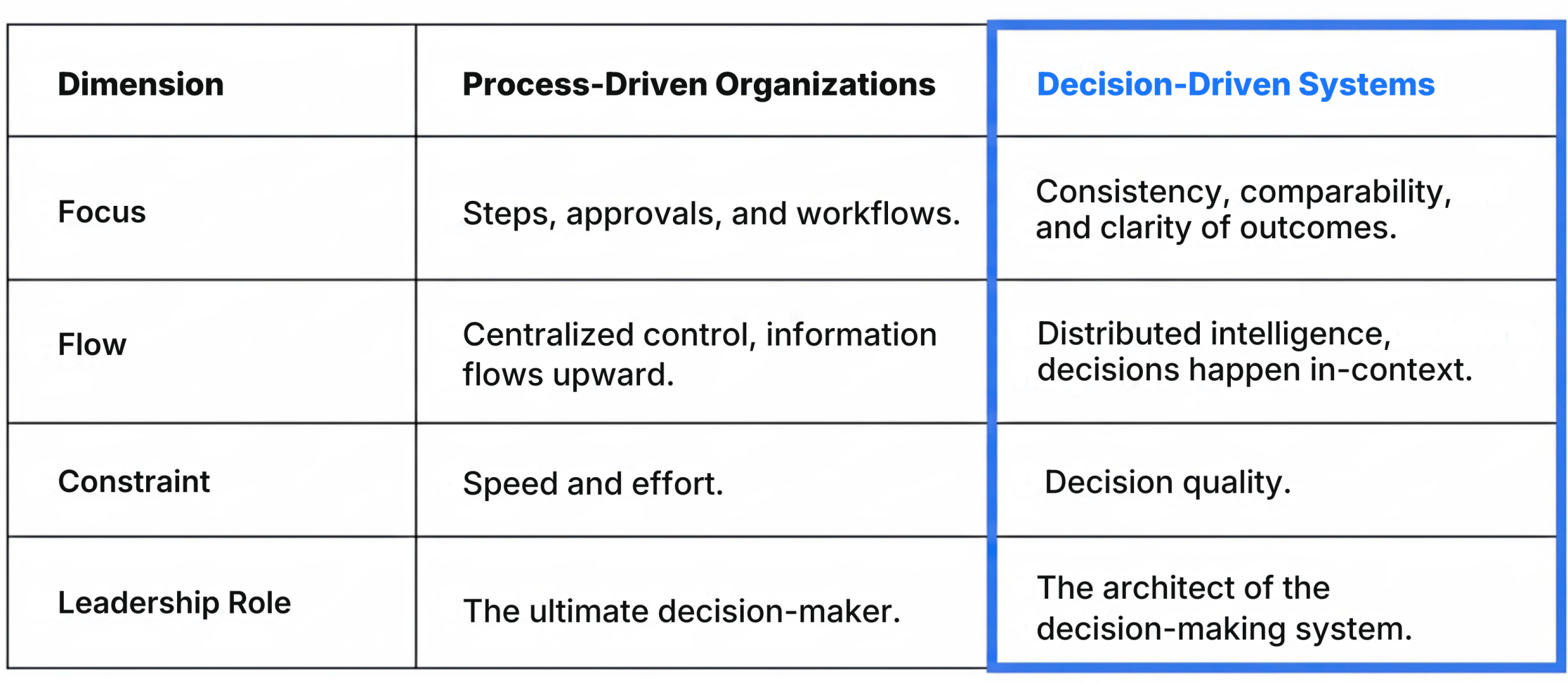
Traditional organizations rely on centralized decision-making. Information flows upward, decisions flow downward, and control sits at the top. This model is already under strain, and AI will break it further.
When intelligence is embedded across systems, waiting for decisions to move through layers becomes inefficient. Organizations need to shift toward distributed decision-making, where intelligence is built into the system and decisions happen closer to where context exists.
This is not about removing leadership. It is about redefining it.
Leadership moves from making decisions to designing the systems that make decisions well.
In our work, we’ve started looking at this as a transition from process-driven organizations to decision-driven systems. The difference is subtle, but the impact is significant.
In practice, this shift is already visible in how hiring decisions are being redesigned. The process is no longer fragmented across resumes, interviews, and scattered feedback; instead, the entire decision is structured as a system.
An AI agent evaluates every candidate on the same criteria, conducts the first round of interviews, and scores responses in real time, creating a comparable decision profile across all applicants, something traditional hiring rarely achieves.
The hiring manager is no longer assembling inputs but reviewing a structured output, with full visibility into why one candidate ranks over another. The human still makes the final call, but the system ensures that every decision is consistent, comparable, and repeatable.
Most enterprises today are still structured around processes. That is why decisions remain inconsistent, dependent on individuals, and difficult to scale.
AI exposes this weakness.
Because once systems are capable of making or supporting decisions at scale, the quality of those decisions becomes the real constraint.
Not speed. Not effort. Not even data.
Decision quality.
If there is one takeaway from Huang’s perspective, it is this: the future will not be defined by how fast organizations execute, but by how well they decide when execution becomes trivial.
That leads to a simple question, but one that most leadership teams have not fully answered.
Because that distinction will define which organizations scale in the AI era, and which ones continue to struggle despite having access to the same technology.
As enterprises connect AI agents to live workflows, security risks extend beyond the model. Learn how prompt injection, excessive access, weak governance and poor oversight can expose business systems—and how leaders can secure AI agents from the start.
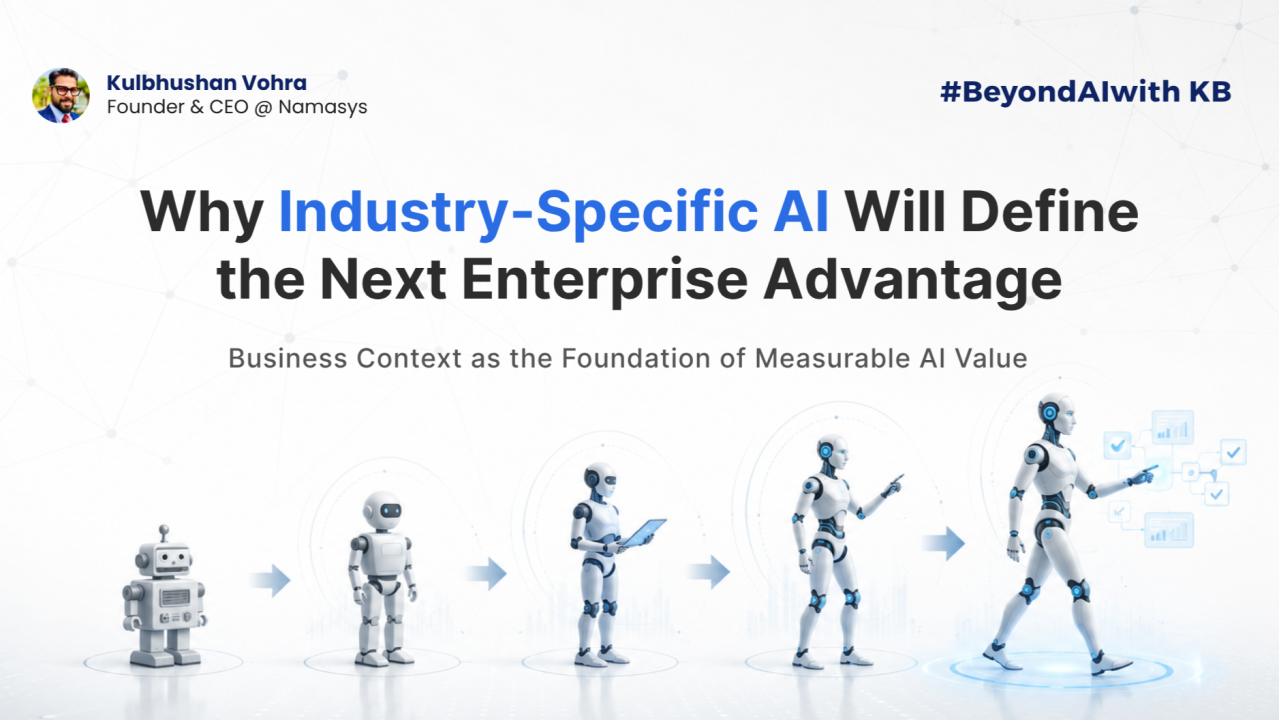
Generic AI improves productivity, but industry-specific AI creates measurable business value by combining enterprise data, workflows, governance and domain expertise. Explore why context will define the next phase of AI adoption.
Namasys Powers What’s Next for Your Enterprise
Bring clarity, efficiency, and agility to every department. With Namasys, your teams are empowered by AI that works in sync with enterprise systems and strategy.