Every enterprise has the same problem right now, and almost nobody is talking about it.
We are deploying AI faster than we are learning to govern it. Faster than we are learning to secure it. The people building the models are rarely the same people who own the consequences when something breaks.
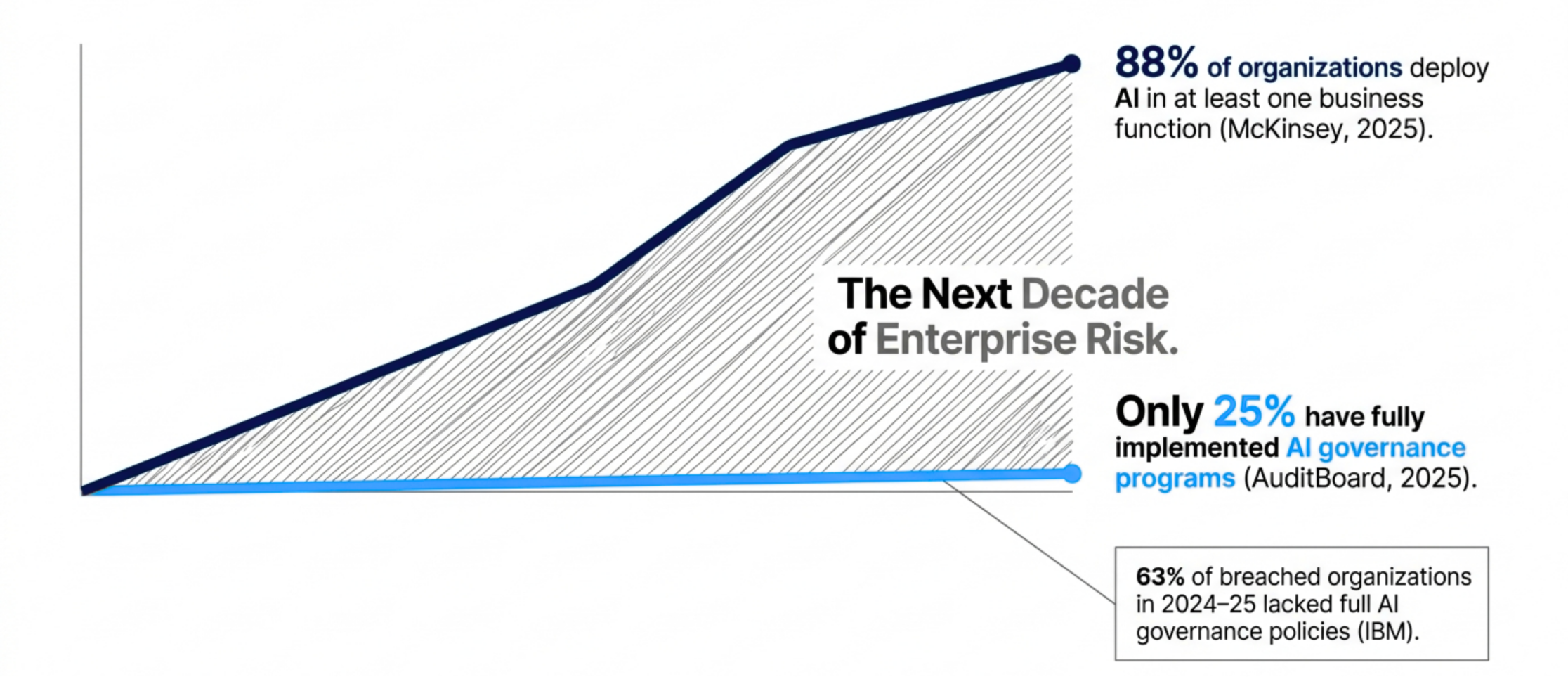
And the gap between speed of deployment and quality of control is where the next decade of enterprise risk is quietly piling up.
The numbers tell the story. 88% of organizations now use AI in at least one business function (McKinsey, 2025). But only 25% have fully implemented AI governance programs (AuditBoard, 2025). And 63% of organizations breached in 2024–25 either had no AI governance policy or were still developing one (IBM Cost of a Data Breach Report, 2025).
We have all skipped the architecture phase and gone straight to scale.
Here is what almost everyone is getting wrong.
AI Governance and AI Security Are Not the Same Thing
They get used interchangeably in board meetings. They should not be.
These are two different disciplines, owned by different teams, solving different problems. Confusing them is how you end up with an AI strategy that looks complete on a slide and falls apart in production.
What Is AI Governance?
AI governance is the rulebook.
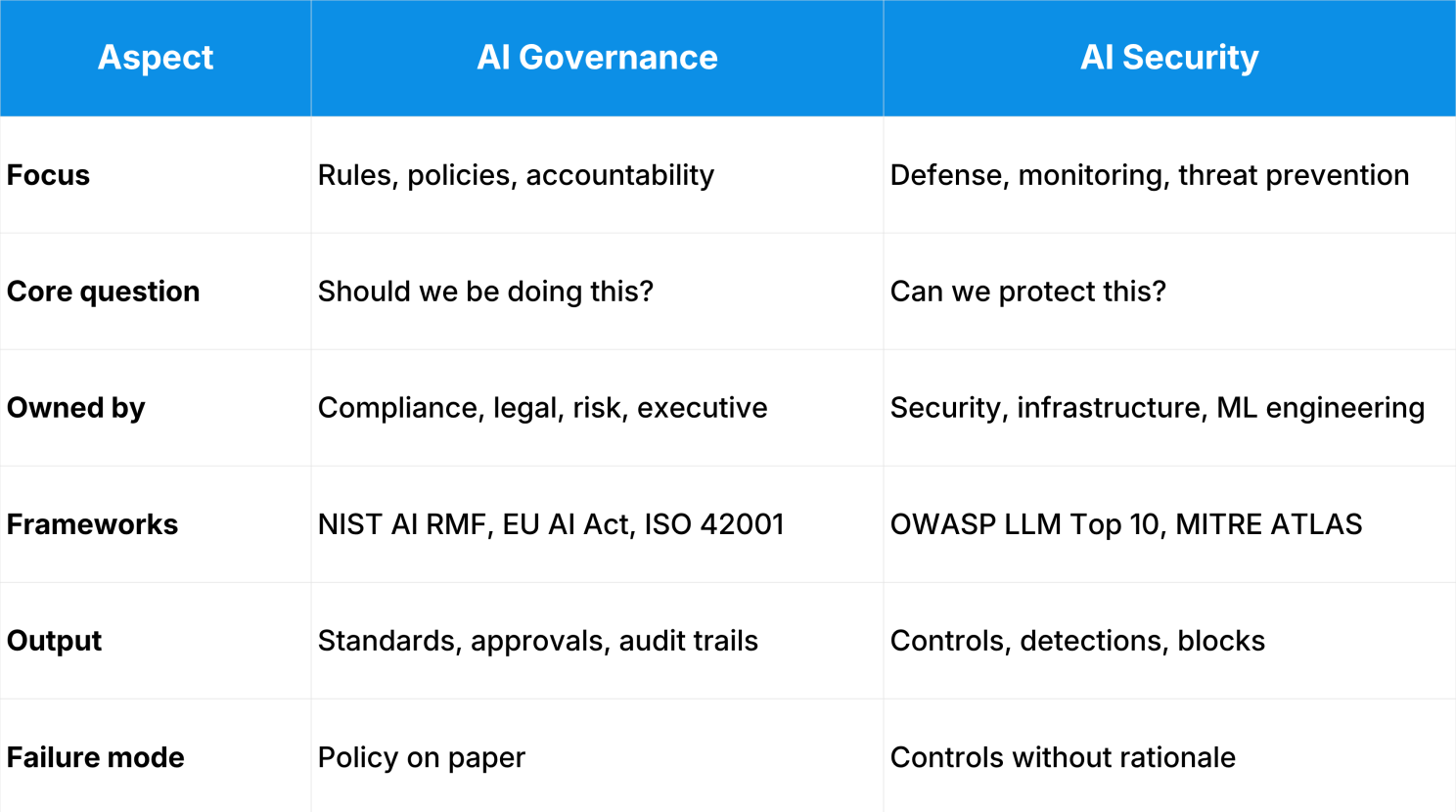
It is the framework of policies, accountability, ethics, and compliance that determines how AI gets used inside an organization. It answers the strategic question: Should we be doing this, and who owns the outcome if it goes wrong?
Governance covers four things:
Policy - what AI can be used for, by whom, on what data
Compliance - alignment with regulations like the EU AI Act, NIST AI RMF, and ISO/IEC 42001
Lifecycle oversight - from model development through deployment to retirement
Accountability - clear ownership across compliance, legal, security, and business units
Governance is direction. It tells the organization what "responsible AI" actually means here.
What Is AI Security?
AI security is the defense layer.
It is the technical discipline of protecting AI systems, models, training data, and outputs from attacks and manipulation. It answers a different question: Can we actually defend this in production?
Security covers a different four:
Threat prevention - defending against prompt injection, jailbreaks, adversarial inputs
Data protection - preventing model theft, training data leakage, unauthorized access
Monitoring - detecting drift, anomalies, and abuse in real time
Incident response - containing breaches when AI systems are compromised
Frameworks like the OWASP LLM Top 10 and MITRE ATLAS define what security teams are defending against.
Security is enforcement. It is what stops attackers from turning your AI into a liability.
The Side-by-Side Most Leaders Have Never Seen
Why One Without the Other Is a Trap
Here is the part most enterprises do not see coming.
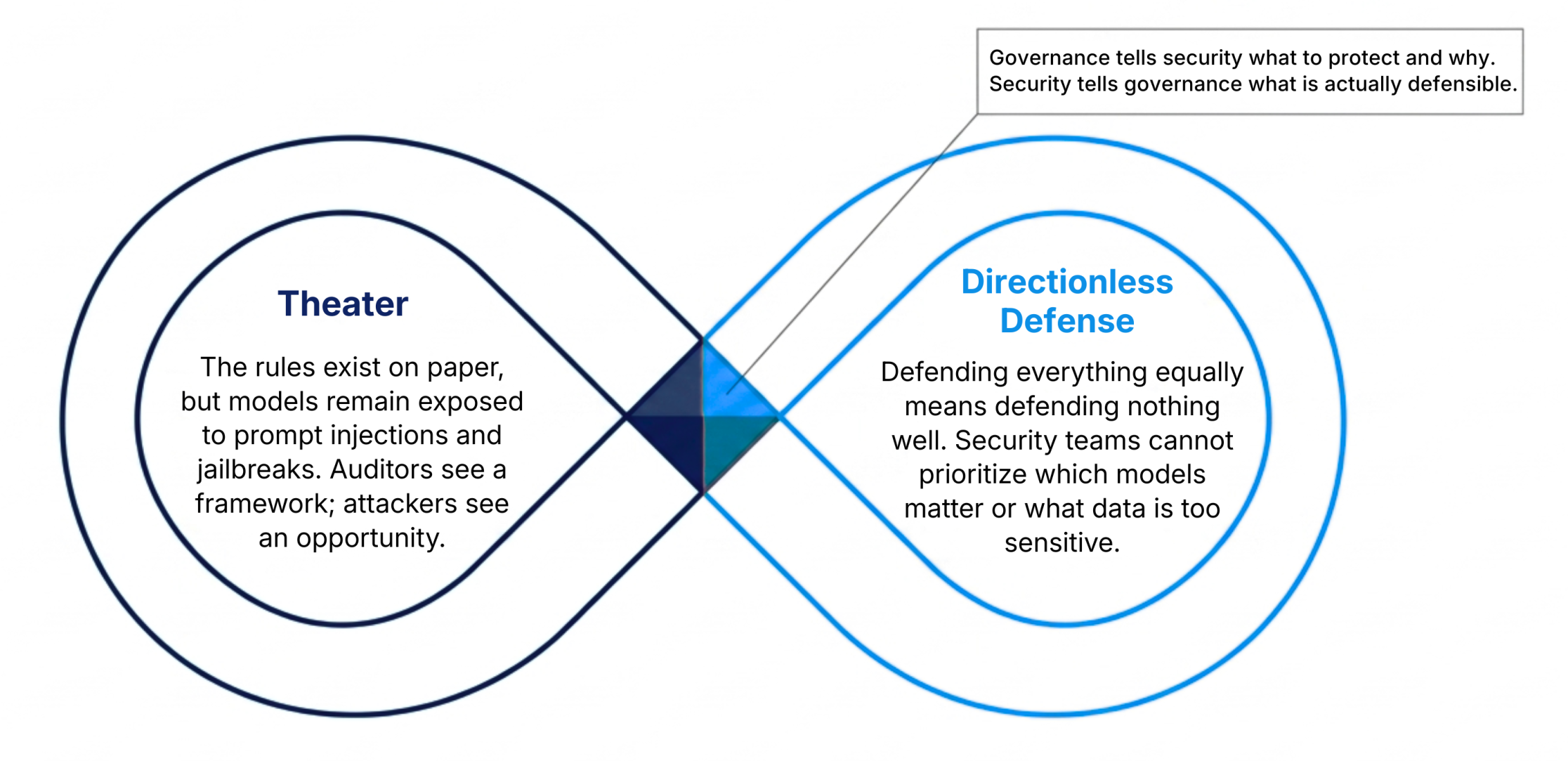
Governance without security is theater.
You can publish the most thorough AI policy in your industry. Ethics committees. Compliance checklists. Approval workflows. None of it matters if your models can be jailbroken, your training data exfiltrated, or your endpoints manipulated through prompt injection.
Security without governance is directionless defense.
A strong security team can lock down infrastructure, monitor traffic, and patch vulnerabilities. But without governance, they cannot prioritize. Which models actually matter to the business? What data is too sensitive to feed into a third-party LLM? What is an acceptable risk level for a customer-facing AI agent?
The Real Problem Nobody Wants to Admit: You Cannot See Your Own AI
Sit with this for a moment.
Most enterprises today cannot answer three basic questions:
How many AI systems are running inside our organization right now?
Who is accountable for each one?
What happens if one of them is compromised tomorrow morning?
If those answers are not clear, you do not have an AI strategy. You have an AI sprawl problem dressed up as innovation.
This is the shadow AI problem, and it is bigger than most leaders realize. IBM's 2025 Cost of a Data Breach Report found that 1 in 5 organizations experienced a breach linked to shadow AI, and those incidents cost an average of $670,000 more than breaches without shadow AI involvement. 97% of AI-related breaches had inadequate access controls. Tools adopted without oversight. Models running without owners. Agents touching production data with no audit trail.
You cannot govern what you cannot see. You cannot secure what you do not know exists.
What to Actually Do About It
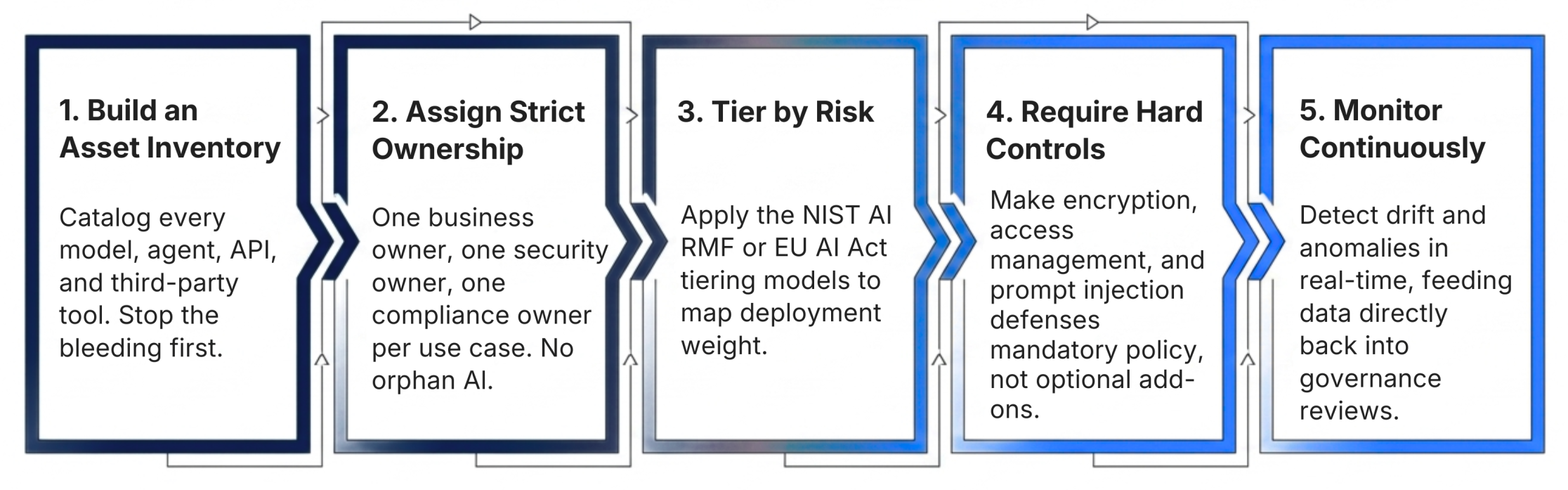
If you lead an organization deploying AI right now, here is the order of operations:
The companies that get this right do not slow down. They speed up. Governance and security remove ambiguity, clarify ownership, and make scaling AI safer than guessing your way through it.
The Window Is Closing Faster Than You Think
Regulators are catching up. Attackers are already there. Customers are starting to ask harder questions about how you handle their data.
The companies that will lead this next decade are not the ones deploying the most AI. They are the ones deploying AI with control, with visibility into every model, accountability for every decision, and defenses against every emerging threat.
Trustworthy AI is not a feature you add later. It is the architecture you build from day one.
You can write the policy after the incident. Or you can build the framework before it.
Take control of your AI strategy before risks escalate. Book your free AI Governance & Security Readiness Assessment with Namasys Analytics today and start closing the gap between ambition and accountability.
As enterprises connect AI agents to live workflows, security risks extend beyond the model. Learn how prompt injection, excessive access, weak governance and poor oversight can expose business systems—and how leaders can secure AI agents from the start.
Generic AI improves productivity, but industry-specific AI creates measurable business value by combining enterprise data, workflows, governance and domain expertise. Explore why context will define the next phase of AI adoption.
Namasys Powers What’s Next for Your Enterprise
Bring clarity, efficiency, and agility to every department. With Namasys, your teams are empowered by AI that works in sync with enterprise systems and strategy.